
What Is a Superheated Water Boiler? How It Differs from a Hot Water Boiler and a Selection Guide
If your process or heating network requires temperatures above 100 °C, but you would rather not deal with the condensate lines, steam traps and water losses of a steam system, a superheated water boiler may be your strongest option. Because superheated water is kept under pressure, it does not boil even at 110–180 °C, and it carries heat in a closed circuit.
So what exactly is the difference between a superheated water boiler and a hot water boiler? And when should it be preferred over steam or thermal oil? In this article, we explain the operating principle, the no-boiling condition, a temperature comparison, the application areas and the points to consider when making your selection.
What Is a Superheated Water Boiler?
A superheated water boiler is a heat generation system that heats water under pressure to above 100 °C, typically in the 110–180 °C range, and circulates it in a closed circuit without evaporating it. Because the system pressure is kept above the saturation pressure of water at that temperature, the water remains in the liquid phase. Heat is transferred to processes or district heating networks as sensible heat.
This is why superheated water is also referred to in the industry as “pressurized hot water”. It travels to the consumers through the flow line, gives up its heat in heat exchangers, air heating coils or process equipment, and, having cooled, returns to the boiler through the return line. A superheated water system consists of the following main components:
- Boiler: The pressurized shell that transfers the heat of the fuel to the water.
- Circulation pumps: Circulate the water through the flow and return lines; they are usually installed with redundancy.
- Pressurization and expansion system: Accommodates the expansion of the heated water and keeps the pressure above the saturation pressure.
- Distribution network and consumers: Heat exchangers, air heating coils and process equipment.
- Safety and control equipment: Safety valves, pressure and temperature limiters, and automation.
The superheated water boiler manufactured by Çiftel is built for solid, liquid or gaseous fuels, in a horizontal or vertical design, and in the capacity the project requires.
What Is the Difference Between a Hot Water Boiler and a Superheated Water Boiler?
Both boilers heat water and circulate it in a closed circuit. The fundamental difference is the operating temperature and the pressure that goes with it. A hot water boiler typically operates in the 90–110 °C range at a low pressure close to atmospheric. A superheated water boiler, on the other hand, operates in the 110–180 °C range under a pressure high enough to prevent the water from boiling.
This is not merely a difference of a few degrees. Higher pressure means that the boiler shell, piping, valves and safety equipment must be selected for a higher design pressure. As pressure equipment, superheated water boilers are designed within the framework of the Pressure Equipment Directive (2014/68/EU, PED).
| Feature | Hot water boiler | Superheated water boiler |
|---|---|---|
| Operating temperature | 90–110 °C | 110–180 °C |
| Operating pressure | Low, close to atmospheric | Above saturation pressure, rises with temperature |
| Pressure management | Standard expansion tank | Nitrogen-cushion or pump-based pressurization |
| Flow–return difference | Narrow (e.g. 90/70 °C) | Wide (e.g. 150/90 °C) |
| Installation | Standard heating installation | Piping, valves and gaskets rated for high pressure and temperature |
| Typical use | Buildings, residential complexes, hotels, hospitals, greenhouses | District heating, process heat, large greenhouses |
An important advantage of superheated water is its wide temperature difference. A line operating with a 150 °C flow and a 90 °C return carries roughly three times as much heat at the same flow rate as a 90/70 °C hot water circuit. On long lines, this means smaller pipe diameters and lower pumping energy. You can determine the required flow rate with our heat load and flow rate calculator.
Why Doesn’t Superheated Water Boil? Pressure and Saturation Temperature
The boiling temperature of water depends on pressure. At an absolute pressure of about 1 bar, water boils at 100 °C; as the pressure rises, the boiling point, i.e. the saturation temperature, rises with it. A superheated water system is based on this rule: to keep the water from boiling, the system pressure must be maintained above the saturation pressure at that temperature.
| Water temperature | Saturation pressure (absolute) | Approximate gauge pressure |
|---|---|---|
| 100 °C | approx. 1.0 bar | approx. 0 bar(g) |
| 120 °C | approx. 2.0 bar | approx. 1.0 bar(g) |
| 150 °C | approx. 4.8 bar | approx. 3.8 bar(g) |
| 180 °C | approx. 10.0 bar | approx. 9.0 bar(g) |
These values are lower limits. In a real system, the pressure must stay safely above the saturation pressure even at the hottest point of the circuit. The design allows a safety margin for the places where pressure drops, such as the highest point of the installation, the pump suction and sudden load changes.
If the pressure falls below the saturation value, the water suddenly flashes into steam. This flashing leads to water hammer and pump cavitation. You can check saturation pressures at different temperatures with our saturated steam table tool.
How is a superheated water system pressurized?
Water expands as it heats up: the volume of water heated from filling temperature to 180 °C increases by approximately 12–13%. The pressurization system both accommodates this volume and keeps the pressure within the required band. There are two common approaches:
- Nitrogen-cushion pressurization: Nitrogen gas sits above the water in a closed tank. Since nitrogen contains no oxygen, it acts as a pressure cushion without increasing corrosion.
- Pressurization with an expansion system: An expansion tank works together with a pressure maintenance unit made up of pumps and relief valves. It takes in the expanding water and pumps it back into the circuit when needed.
The method is selected according to the system volume, the temperature and the operating conditions. For a first estimate of the expansion volume, you can use the expansion tank calculator. Final sizing, however, should be carried out as part of the project engineering.
Superheated Water, Steam and Thermal Oil: Temperature Comparison
For high-temperature heat demand, there are four main options: hot water, superheated water, saturated steam and thermal oil. Each has a different temperature range and a different relationship with pressure.
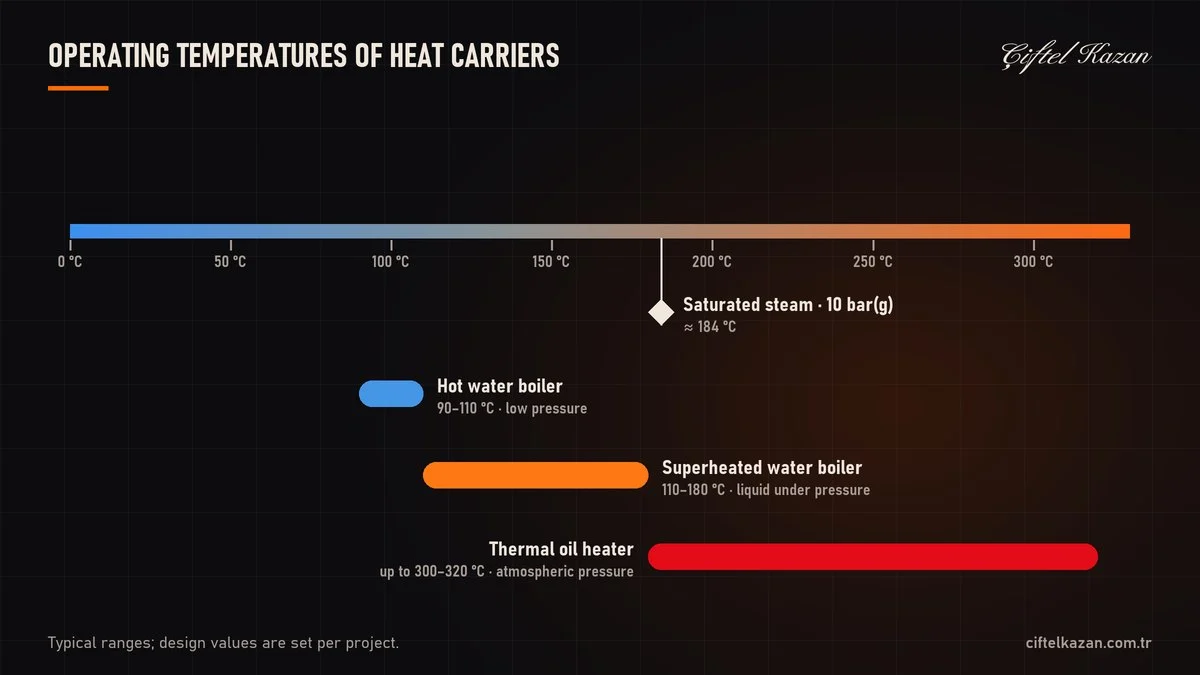
| Medium | Typical temperature | Pressure | How does it carry heat? | Where it stands out |
|---|---|---|---|---|
| Hot water | 90–110 °C | Low | Sensible heat, closed circuit | Building and greenhouse heating |
| Superheated water | 110–180 °C | Above saturation pressure (at least approx. 10.0 bar absolute at 180 °C) | Sensible heat, closed circuit | District heating, indirect process heat |
| Saturated steam | Approx. 184 °C at 10 bar(g) | Temperature is set by pressure | Heat of condensation; condensate return required | Processes that need direct steam |
| Thermal oil | Up to 300–320 °C | Atmospheric pressure | Sensible heat, closed circuit | Processes above 200 °C |
A practical reading is as follows: up to 110 °C, hot water is usually sufficient. In the 110–180 °C range, superheated water competes with steam; if the product does not need to be supplied with steam directly, superheated water generally offers simpler operation. Above 200 °C, thermal oil comes to the fore, as it reaches these temperatures without going to high pressure.
We discuss the choice between thermal oil and steam in our article thermal oil boiler or steam boiler?, and thermal oil systems in our thermal oil boiler selection guide.
Where Are Superheated Water Systems Used?
Superheated water is a natural candidate for applications in which heat does not need to be delivered to the product directly as steam. Heat is transferred indirectly via a heat exchanger or a coil. The main areas of use are:
- District heating: Long-distance heat distribution at the scale of a campus, a residential complex, an organized industrial zone or a city. The wide temperature difference reduces pipe diameters and pumping energy.
- Greenhouses: In large greenhouses, superheated water is carried in the main line and supplied into the greenhouse at a suitable temperature through a heat exchanger or a mixing valve.
- Industrial processes: Indirect heating requirements in the 110–180 °C range in the food, textile, chemical and paper industries.
- Ventilation and drying coils: Air heating coils in drying ovens, paint booths and large air handling units.
At Çiftel, the first two questions when starting a superheated water project are always the same: at what temperature do your consumers need heat, and at what temperature does the return water come back? The boiler’s design pressure, the pump selection and the pressurization system are all derived from these two values.
What Are the Advantages of a Superheated Water Boiler?
- Closed circuit, low water loss: Because the water circulates continuously, the need for make-up water is low. Water treatment and chemical costs are reduced.
- No condensate or steam trap losses: Since there is no phase change, the losses typical of steam systems, such as steam trap failures, flash steam and condensate that is never returned, do not occur.
- Stable temperature: The large volume of water in the boiler and the circuit acts as a thermal buffer, damping fluctuations during sudden load changes.
- Flexible temperature control: With mixing valves, consumers that need different temperatures can be supplied from the same circuit.
- Efficient transport over long distances: Thanks to the wide temperature difference, more heat is carried through the same pipe.
Key Considerations in a Superheated Water System
Pressure and expansion management
The safety of the system depends on the pressure staying above the saturation pressure under all conditions. The pressurization unit, safety valves, pressure and temperature limiters and automation must be designed together. Expansion behavior should be monitored during initial filling and commissioning.
Circulation pump
In a superheated water boiler, the pump is the lifeline of the system. If circulation stops, the water in the boiler can overheat locally and flash into steam. For this reason, the pumps are usually installed with redundancy, and cavitation is prevented by keeping the pressure on the suction side above the saturation pressure. In solid-fuel systems, since the fuel in the furnace does not go out immediately, a power-failure scenario must also be addressed in the project.
Minimum return temperature
If the return water comes back too cold, flue gas can condense on the cold surfaces of the boiler. With sulfur-containing fuels in particular, this condensate is acidic and causes corrosion. The return temperature should not fall below the minimum specified by the manufacturer; if necessary, the return water should be warmed by a mixing valve or a bypass line before it enters the boiler.
Water quality
Even though it is a closed circuit, the system should be filled with softened, deaerated water. Hardness forms scale in the pipes and reduces heat transfer, while dissolved oxygen accelerates corrosion. We cover the subject in detail in our article on deaerators and oxygen in feedwater.
Superheated Water Boiler or Hot Water Boiler? Selection Guide
Required temperature and line length
If the consumers operate below 100 °C and the lines are short, a hot water boiler is economical and sufficient. If heat above 110 °C is required, or if heat has to be transported over long distances, a superheated water boiler is the better investment.
Superheated water or steam?
Processes that apply steam directly to the product, such as cooking, sterilization or humidification, require a steam boiler. If the heat is transferred through a heat exchanger, superheated water reaches the same temperature range without the hassle of condensate lines and steam traps.
Fuel selection
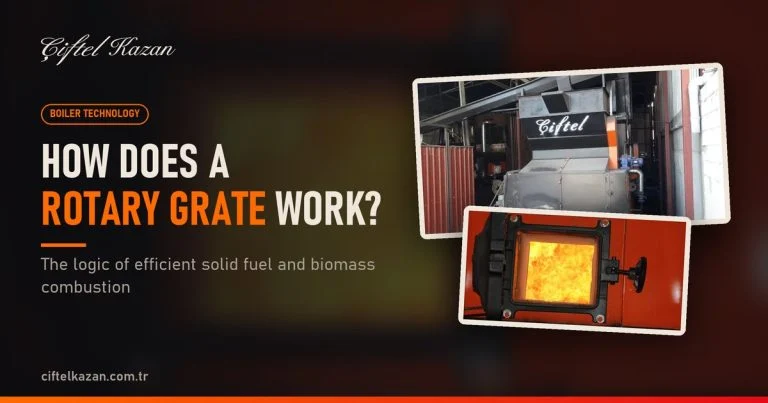
A superheated water boiler can run on solid, liquid and gaseous fuels. Natural gas and liquid fuels are fired with a burner. With solid fuel, the boiler works together with a rotary-grate solid fuel combustion system.
Coal, biomass and suitable production residues are fed automatically, and the ash is discharged automatically. Çiftel’s patented rotary grate is sized according to the calorific value, ash content and moisture content of the fuel.
Capacity
Capacity is determined by evaluating the total heat load, the flow and return temperatures and the load profile together. Taking future expansion plans into account from the outset makes it easier to add a second boiler or pump group later on.
Conclusion: The Right Medium, the Right Boiler
A superheated water boiler is a strong option for plants that want to carry heat in the 110–180 °C range in a closed circuit, without the condensate losses of steam. Success depends on correct pressurization, redundant pumps, hydraulics designed around the minimum return temperature and well-treated water.
At Çiftel Kazan, we have been manufacturing steam, superheated water, hot water and thermal oil boilers at our plant in Kemalpaşa, İzmir since 1986. To evaluate the temperature and capacity requirements of your facility together, contact us or call us on +90 232 479 11 21 / +90 544 479 11 21.
Frequently Asked Questions
A superheated water boiler typically operates in the 110–180 °C range. The water is kept under pressure so that it does not boil at these temperatures. For example, the saturation pressure at 150 °C is approximately 4.8 bar absolute, and the system pressure must be above this value. The exact operating temperature is set in the project according to the temperature the consumers need and the return water temperature.
Superheated water carries heat in liquid form and gives it up as its temperature falls; steam, by contrast, releases its latent heat at a constant temperature as it condenses. Steam is indispensable in processes that require direct contact with the product, but it needs condensate lines and steam traps. Because superheated water circulates in a closed circuit, water losses are low and operation is simpler, which is why it is frequently preferred for indirect heating.
The pressure of a superheated water boiler is determined by its operating temperature and is kept above the saturation pressure of the water. Approximate saturation values are 2.0 bar at 120 °C, 4.8 bar at 150 °C and 10.0 bar at 180 °C, in absolute pressure. The design pressure is selected by adding to these values a safety margin for the highest point of the installation and the pump suction.
An expansion tank is needed because water increases in volume as it heats up, and in a closed circuit this expansion must be accommodated safely. Water heated from filling temperature to 180 °C grows in volume by approximately 12–13%. The expansion and pressurization system accommodates this volume while keeping the pressure above the saturation pressure. This prevents flashing, water hammer and unnecessary safety valve openings.
A superheated water boiler can run on solid, liquid and gaseous fuels. Natural gas and liquid fuels are fired with a burner. For solid fuel, a rotary-grate combustion system automatically feeds coal, biomass and suitable production residues and discharges the ash automatically. The fuel should be selected by evaluating fuel availability, cost and the plant’s emission requirements together.
For small and medium-sized greenhouses, a hot water boiler is usually sufficient. In large greenhouses with long main distribution lines, however, superheated water carries more heat through smaller pipe diameters thanks to its wide temperature difference. It is supplied into the greenhouse at a suitable temperature via a heat exchanger or a mixing valve. The decision should be based on the total heat load and the line length.
Other Posts
All
Need a boiler or pressure vessel?
Let’s plan the best solution for your project together, backed by 40 years of engineering experience.