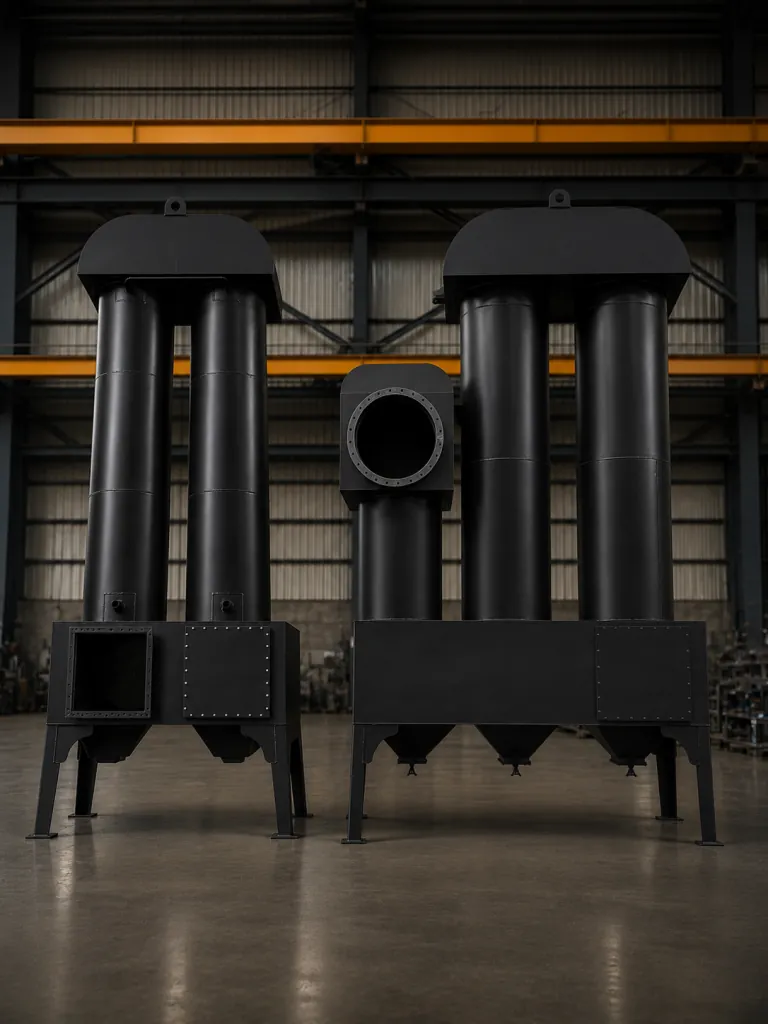
A Type D boiler is a water-tube steam boiler design in which a steam drum at the top and a water drum at the bottom are connected by tubes curved in the shape of the letter “D” on the side. Preferred in facilities with continuous and intensive steam consumption due to its compact design, high capacity, and suitability for high pressure, Çiftel Kazan designs and manufactures D-type water-tube boilers specifically for each project; we also have a track record of delivering D-type boilers internationally.
What is a D-type water-tube boiler?
It gets its name from the arrangement of the tubes surrounding one side of the combustion chamber, which resembles the letter “D” in cross-section. A convection tube bundle is located between the upper (steam) drum and the lower (water) drum; the walls of the combustion chamber are typically surrounded by membrane walls consisting of tubes welded together. These walls not only make the furnace gas-tight but also function as a heating surface that transfers radiant heat directly to the water.
How does a D-type boiler work?
The flame emerging from the burner transfers most of its heat by radiation to the wall tubes within the combustion chamber, which is surrounded by membrane walls. The gases then pass through the convection tube bundle, releasing the remaining heat, and proceed toward the flue. The water-steam mixture in the tubes rises to the steam drum due to the difference in density; separators inside the drum separate the steam from the water, while the water returns to the lower drum via the downcomer tubes. This natural circulation allows the boiler to respond quickly to load changes.
Advantages of the D-Type Boiler
- High capacity, compact body: The efficient arrangement of radiation and convection surfaces allows a large capacity to fit into a small area.
- High-pressure capability: The water-tube design economically meets high-pressure steam requirements.
- Quick startup and load tracking: Thanks to its relatively small water volume, the boiler reaches operating pressure quickly.
- Gas-tight furnace: Membrane walls make the combustion chamber leak-proof, reducing the need for refractory materials.
- Package production capability: Boilers of suitable capacities can be fully assembled in the workshop and shipped as a single unit; this shortens on-site installation time.
For which facilities is the D-type boiler suitable?
Industrial facilities with high and continuous steam consumption—such as energy and cogeneration plants, chemical and petrochemical plants, sugar, food, and dairy processing plants, as well as paper and textile mills—along with large central heating systems in hospitals and university campuses are the primary applications for Type D boilers. Type D boilers are most commonly operated with natural gas and liquid fuel burners.
Comparison of Type D, Scotch, and Header-Type Boilers
| Criterion | Type D water-tube | Scotch-Type | Header-type water-tube |
|---|---|---|---|
| Construction | Two drums, membrane-walled furnace | Furnace tube and smoke tubes in the shell | Tube bundle between the header boxes |
| Capacity / Pressure | High | Small–medium | Medium–high |
| Typical fuel | Natural gas, liquid fuel | Natural gas, liquid fuel | Coal, biomass (rotary grate) |
| Commissioning | Fast | Slower | Fast |
For facilities wishing to use solid fuel, a header-type water-tube rotary grate boiler or a hybrid boiler capable of operating with solid, liquid, and gaseous fuels may be more suitable. We have explained the general structure of water-tube boilers in our water-tube boiler guide.
D-Type Boiler Production at Çiftel Kazan
We design our D-type boilers according to the steam capacity, operating pressure, fuel type, and installation space required for each project. Thermal calculations, manufacturing, quality control, assembly, and commissioning are carried out by our own team at our facility in Kemalpaşa, Izmir. To increase efficiency, we recommend preheating the feedwater using an economizer. We have delivered a Type D boiler to a university in Iraq; you can find our other projects on the References page.