
What Is a Deaerator? The First Line of Defense Against Oxygen and Corrosion in Boiler Feedwater
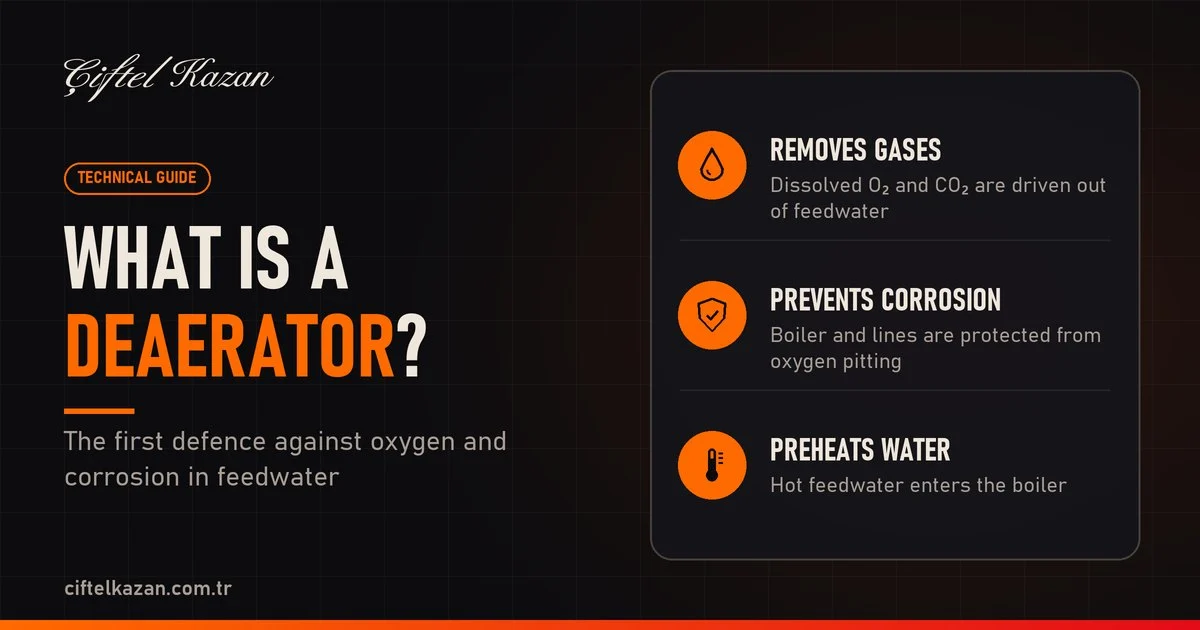
One of the most insidious enemies that shortens the lifespan of a steam boiler is invisible: oxygen dissolved in the feedwater. Oxygen causes slow but steady corrosion on the inner surfaces of the boiler, feed lines, and economizer. This corrosion is often only noticed when a pipe springs a leak. This is where the deaerator comes in—it’s the equipment used to address this problem at its source.
In this article, we explain what a deaerator is, how it works, what types are available, and what benefits it brings to operations.
Why Are Gases in Feedwater Dangerous?
Municipal or well water contains dissolved gases because it comes into contact with air. The two most important gases from the boiler’s perspective are:
- Oxygen (O2): At high temperatures, it reacts rapidly with steel and causes pitting corrosion, which progresses in the form of small, deep pits on the surface. Since this type of corrosion progresses in localized spots rather than causing widespread thinning, a pipe that generally appears structurally sound can unexpectedly develop holes.
- Carbon dioxide (CO₂): It is carried into the system along with steam and dissolves in the condensate to form carbonic acid. This leads to corrosion in the form of wall thinning, particularly in condensate return lines.
These reactions accelerate as temperature increases. Therefore, an amount of oxygen that seems insignificant in cold water can become a source of serious damage at boiler temperatures.
How Does a Deaerator Work?
The deaerator’s operating principle is based on a simple law of physics: The amount of gas that can dissolve in a liquid decreases as the temperature rises. When water is heated to its boiling point, it releases most of the gases it contains.
In the deaerator, feedwater is heated to the saturation (boiling) temperature using steam drawn from the boiler. The water is atomized into fine droplets or made to flow over trays to increase the surface area in contact with the steam. The oxygen and carbon dioxide separated from the water are discharged through the vent line along with a small amount of steam. The deaerated water is collected in a tank beneath the deaerator and sent to the boiler via feed pumps.
Pressurized deaerators typically operate at a pressure slightly above atmospheric pressure, typically around 0.2–0.5 bar; at this pressure, the water temperature is approximately 105–110 °C. A properly designed and operated deaerator can reduce dissolved oxygen to very low levels.
Types of Deaerators
| Type | Operating Principle | Evaluation |
|---|---|---|
| Tray deaerator | Water comes into contact with steam as it flows through stacked trays. | Effective over a wide load range; commonly used for large capacities. |
| Spray deaerator | Water is sprayed into the steam environment through nozzles. | Compact design; requires careful engineering for variable loads. |
| Atmospheric feedwater tank | The water in the tank is heated by steam or condensate; it is unpressurized. | Since it cannot bring the water to its boiling point, it only partially removes oxygen; it is generally used with chemical support. |
Which type is suitable is determined based on boiler capacity, operating pressure, condensate return rate, and the plant’s approach to water treatment.
Does a Deaerator Replace Chemical Treatment?
Not entirely, but it significantly reduces the burden. The deaerator mechanically removes most of the oxygen; the very small amount of oxygen remaining is then removed using oxygen-binding chemicals. In a system without a deaerator, much larger quantities of these chemicals would be required. This results in both direct costs and an increase in the amount of dissolved solids in the boiler water, which in turn leads to more frequent blowdowns.
We have discussed the entire process of water treatment (softening, chemical dosing, blowdown) in detail in our article on boiler water treatment.
Benefits of a Deaerator to Operations
- Longer boiler life: Prevention of oxygen corrosion; protects boiler tubes, feed lines, and the economizer.
- Reduced chemical usage: Consumption of oxygen-scavenging chemicals is significantly reduced.
- Preheating of feedwater: Since hotter water enters the boiler, less fuel is consumed to produce the same amount of steam. It is generally accepted that every 6 °C increase in feedwater temperature results in approximately a 1% fuel savings.
- Reduced thermal shock: Stress caused by injecting cold water into a hot boiler is reduced.
- Protection of the condensate system: The removal of carbon dioxide reduces acidic corrosion in the condensate lines.
The Deaerator and Condensate System Should Be Considered Together
The deaerator is typically located at the point where the condensate return and makeup water meet. Recovering hot condensate reduces the amount of steam needed to heat the deaerator and minimizes the inflow of fresh water—and thus fresh oxygen—into the system. We explained why condensate is so valuable, complete with calculations, in our article on condensate return.
Points to Consider During Operation
- Pressure and temperature must be maintained at constant levels: If the deaerator operates below the design pressure, the water will not reach its saturation temperature, and the gases will not be fully separated.
- The vent line must remain open: It is normal for a small stream of steam to continuously escape from the vent line; this indicates that gases are being expelled from the system. Closing the vent valve completely to reduce steam loss causes gases to remain in the deaerator.
- Level control: The water level in the tank must be monitored to ensure the boiler’s feedwater safety.
- Feed pump suction: Since the water drawn from the deaerator is near its boiling point, the deaerator is typically positioned at a higher elevation to prevent the pumps from experiencing cavitation.
- Periodic measurements: Dissolved oxygen in the feedwater and boiler water parameters must be measured regularly.
Let’s Evaluate Your Boiler Room Together
As Çiftel Kazan, we have been manufacturing steam, thermal oil, and hot water boilers at our facility in Kemalpaşa, İzmir, since 1986. Contact us or reach out via the +90 232 479 11 21 / +90 544 479 11 21 numbers to assess the current status of your boiler room together and discuss what can be done to improve efficiency and reduce costs.
Frequently Asked Questions
The boiler will operate; however, if oxygen is not removed from the feedwater, the risk of corrosion increases, and this risk can only be mitigated by using large amounts of chemicals. Especially in high-pressure and water-tube boilers, as well as in systems with economizers, the deaerator plays a crucial role in extending the boiler’s service life.
Partially. An atmospheric tank removes some of the oxygen by heating the water, but since it cannot bring the water to its boiling point, it is not as effective as a pressurized deaerator. For this reason, it is generally used in conjunction with chemical treatment.
The oxygen and carbon dioxide separated from the water must be discharged along with a small amount of steam. This minor steam loss is normal and is the price paid for preventing corrosion.
Since the deaerator heats the feedwater, hotter water enters the boiler. Because the steam used for heating remains within the system—especially when considered in conjunction with the condensate return—it makes a positive contribution to the overall energy balance.
Other Posts
All

Need a boiler or pressure vessel?
Let’s plan the best solution for your project together, backed by 40 years of engineering experience.