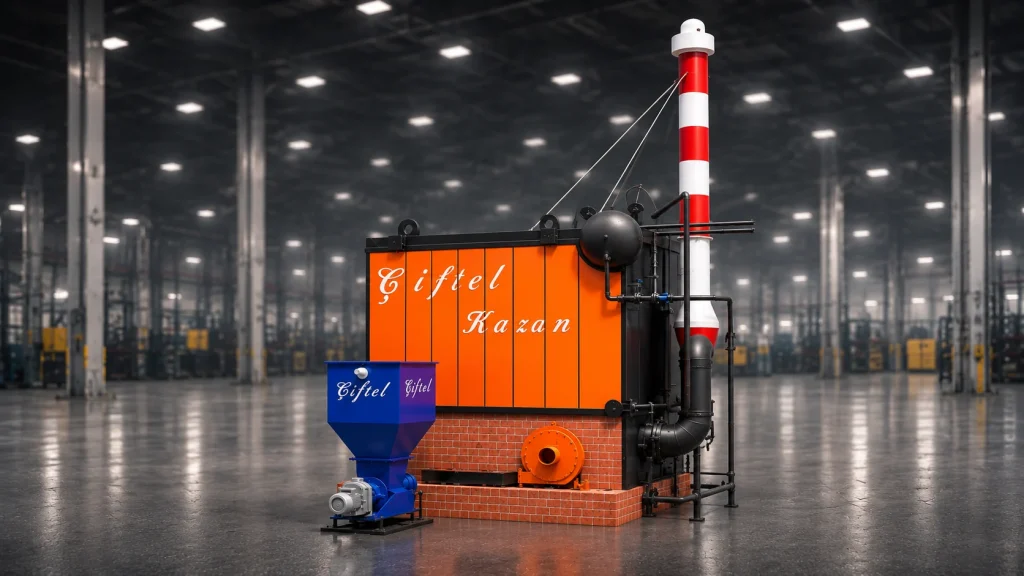
A steam boiler is a pressurized piece of equipment that generates pressurized steam by transferring the heat released from fuel combustion to water and then delivers this steam to production processes, heating systems, or power generation. Çiftel Kazan has been designing and manufacturing water-tube, Scotch-type, and hybrid industrial steam boilers at its 45,000 m² facility (15,000 m² of which is indoor) in Kemalpaşa, Izmir, since 1986; and has completed more than 1,250 projects to date.
What is a steam boiler, and how does it work?
In a steam boiler, fuel is burned in the furnace (combustion chamber). As the resulting hot gases pass through the heat transfer surfaces, they transfer their heat to the water; the water reaches its boiling point, turns into steam, and is collected in the steam drum (steam tank). The steam exiting the boiler is delivered at its pressure and temperature to various processes within the facility, such as cooking, drying, sterilization, dyeing, and heating. Condensate is collected as much as possible and returned to the boiler.
To ensure safe boiler operation, level, pressure, and temperature controls work in conjunction with safety valves and automatic control systems. The treatment of feedwater (water softening, deoxygenation, blowdown) directly determines the boiler’s service life.
Types of Steam Boilers
Industrial steam boilers are divided into two main groups based on where water and hot gases circulate: water-tube boilers and fire-tube (Scotch-type) boilers. Hybrid boilers, which combine the advantages of both designs, offer a third option.
Water-tube Steam Boiler
Water circulates inside the tubes, while hot gases circulate outside the tubes. It is suitable for high pressure and high capacity, produces steam quickly, and allows for a wide combustion chamber design for solid fuels. Çiftel Kazan manufactures the following models in this group: header-type water-tube steam boilers with rotary grates, packaged water-tube boilers, stoker-fired water-tube boilers, and D-type water-tube boilers. For details, please refer to our water-tube boiler guide.
Scotch-type (fire-tube) steam boiler
Hot gases flow through the tubes, while water circulates in the shell surrounding the tubes. Thanks to its large water volume, it maintains stable pressure during load changes; it is widely used with natural gas and liquid fuel burners. Çiftel Kazan’s natural gas-fired Scotch-type steam boiler features a three-pass smoke-tube design.
Hybrid steam boiler
The hybrid water-tube rotary grate steam boiler combines a top-mounted Scotch-type three-pass shell with a water-tube radiation section at the bottom. This combines the large water capacity of the Scotch-type design with the rapid steam production of the water-tube structure in a single unit; it can operate on solid, liquid, or gaseous fuels and achieves a thermal efficiency of over 90%.
| Features | Water-tube | Scotch-Type | Hybrid |
|---|---|---|---|
| Location of water | Inside the tubes | Shell (outside the tubes) | Both |
| Pressure and capacity | High | Low–medium | Medium–high |
| Steam production rate | Fast | Slower, steady | Fast and steady |
| Suitable fuels | Coal, biomass, gas, liquid | Natural gas, liquid fuel | Solid, liquid, gas |
Steam boilers by fuel type
- Natural gas and liquid fuel boilers: operate with a burner; offer the advantages of clean combustion, easy automation, and a compact boiler room. Natural gas boiler guide
- Coal- and biomass-fired boilers: automatically fed via a rotary grate or stoker system; ideal for facilities with continuous steam consumption where fuel cost is a key factor. Coal-fired boiler guide
- Multi-fuel boilers: Designs capable of operating with gas or liquid fuel in addition to solid fuel reduce risks associated with fuel supply.
What to Consider When Selecting a Steam Boiler?
- Steam capacity (kg/h or t/h): The simultaneous demand of all consumers in the facility, future additions to the system, and the load profile must be calculated together. Our article on capacity selection
- Operating pressure: The temperature required by the process determines the steam pressure; higher-than-necessary pressure increases both investment and operating costs.
- Fuel: Local fuel prices, supply reliability, storage space, and emission regulations must all be evaluated together.
- Boiler type: Load fluctuations, desired steam quality, and available space influence the choice between water-tube, Scotch, or hybrid boilers. Scotch or water-tube?
- Water treatment: No boiler will have a long service life without softening, a deaerator, and a blowdown system. Boiler water treatment
- Service and spare parts: The manufacturer’s assumption of responsibility from site survey to commissioning, along with 24/7 service and spare parts support, determines operational safety.
Factors Determining Steam Boiler Prices
A steam boiler price cannot be given as a single figure; it is calculated on a project-by-project basis. The main factors determining the price are as follows:
- Capacity and design pressure (material thickness and heat transfer surface area)
- Boiler type and combustion system (burner, rotary grate, stoker)
- Level of automation and safety equipment
- Auxiliary equipment such as economizers, recuperators, deaerators, feedwater systems, and water treatment systems
- Transportation, installation, chimney, and boiler room infrastructure
Operating costs are just as important as the initial investment: fuel is the largest expense over the boiler’s lifespan. Therefore, we recommend comparing quotes not only based on price but also on efficiency and fuel consumption.
Equipment that increases efficiency
- Economizer: Preheats feedwater using the waste heat from flue gases. Fuel savings with an economizer
- Recuperator: Preheats combustion air using waste heat to ensure more complete combustion.
- Condensate return: Recovers the heat from condensed steam and returns the treated water to the boiler. How much does it save?
- Deaerator: Removes oxygen from the feedwater to prevent corrosion. What is a deaerator?
Steam Boiler Manufacturing at Çiftel Kazan
Feasibility studies, engineering calculations, manufacturing, quality control, installation, and commissioning are all carried out under one roof by our own team. Our boilers operate with a thermal efficiency ranging from 85% to 95%, depending on the boiler type, fuel, and operating conditions. We hold four registered patents for our combustion system, our multi-pass boiler with a rotary grate, our steam boiler baffle configuration, and our improved recuperator. We manufacture CE-marked products and operate under the ISO 9001, ISO 14001, ISO 45001, ISO 10002, and EN ISO 3834-2 certifications. You can view our projects in sectors such as food, dairy, textiles, paper, chemicals, pharmaceuticals, and energy on our references page.