
D-Type Boiler or Header-Type Boiler? The Real Difference Between Two Water-Tube Boilers
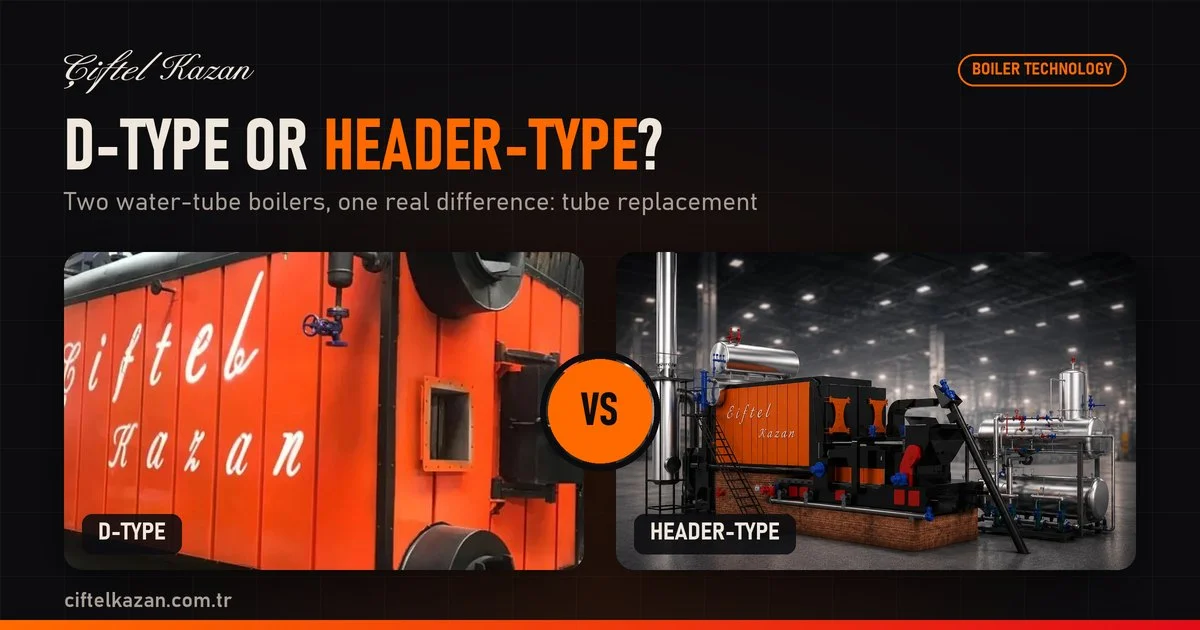
The most frequently asked question in a high-capacity steam boiler investment is: D-type boiler or header-type boiler? Both are water-tube boilers. In both, water circulates inside the tubes, and flames and hot gases heat the tubes from the outside. Both are suitable for high pressure and capacity. These two boilers, which appear very similar on paper, yield completely different results over the 15–20 years of operation. The difference is created by how the tubes are connected to the boiler and what happens when a tube fails.
As Çiftel Kazan, we have been manufacturing both D-type and our patented header-type water-tube boilers at our facility in Kemalpaşa, İzmir, since 1986. In this article, we compare the two designs in terms of structure, maintenance, tube replacement, fuel, and lifetime cost.
What is the Fundamental Difference Between D-Type and Header-Type Boilers?
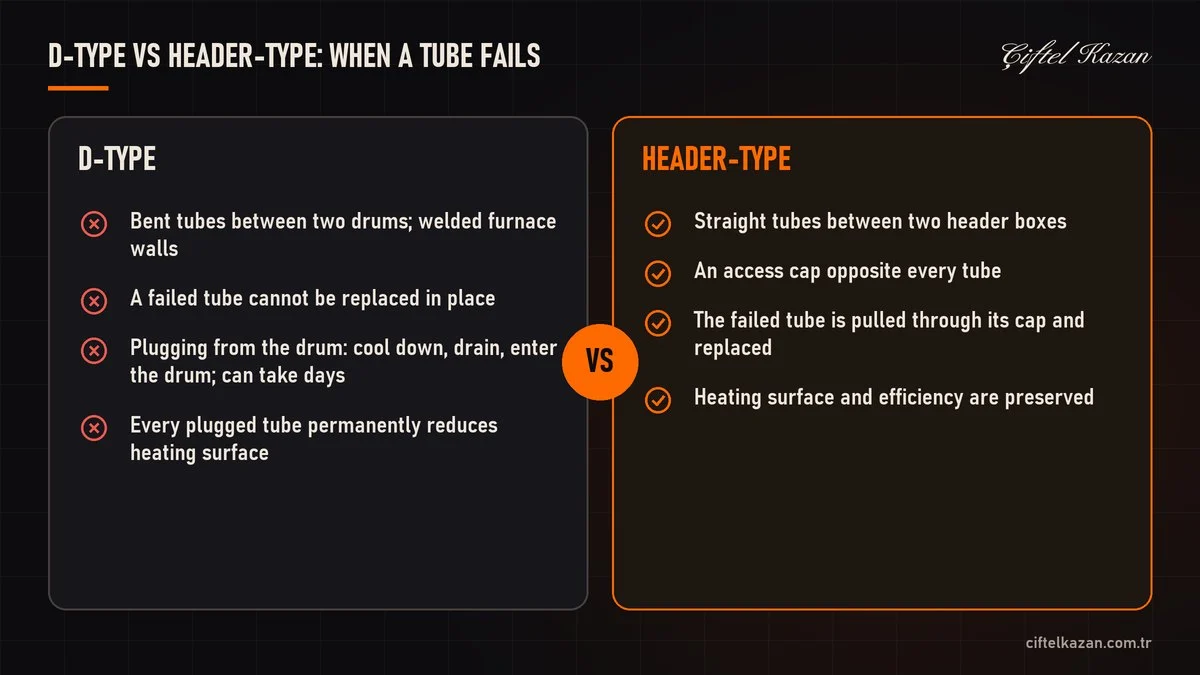
The fundamental difference lies in the tube connection. In a D-type boiler, bent tubes are connected between the upper steam drum and the lower water drum. The furnace walls consist of welded membrane tubes. Therefore, a faulty tube cannot be replaced in situ; it can only be plugged. In a header-type boiler, straight tubes are expanded and connected between two header boxes. By opening the maintenance cover opposite each tube, the tube can be individually removed and replaced.
This single difference directly determines maintenance time, downtime cost, the boiler’s efficiency over the years, and its total lifespan. Let’s first briefly introduce the two designs.
How Does a D-Type Water-Tube Boiler Work?
A D-type boiler gets its name from the arrangement of the tubes surrounding the combustion chamber, which resembles the letter “D” in cross-section. There is a steam drum at the top and a water drum at the bottom. The convection tube bundle between them and the membrane-walled combustion chamber fit a large heating surface into a compact body. The heat from the flame exiting the burner is first transferred to the membrane walls by radiation, then to the tube bundle by convection. The water-steam mixture rises to the steam drum by natural circulation.
D-type boilers are most commonly operated with natural gas and liquid fuel burners. They offer a compact solution for high capacity, start up quickly, and respond rapidly to load changes. We explained the design details in our D-type boiler guide.
How Does a Header-Type Water-Tube Boiler Work?
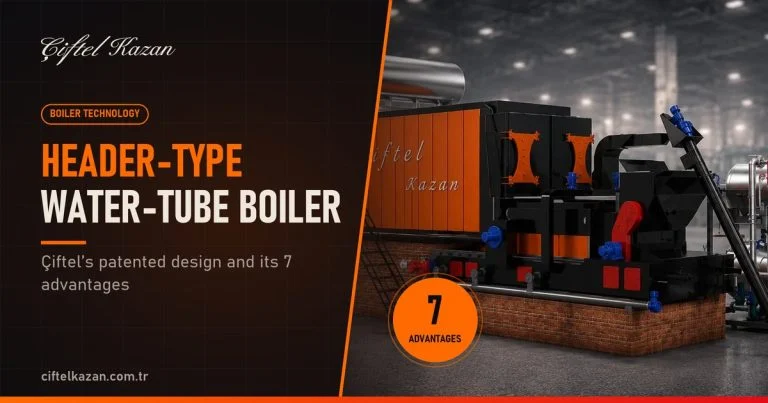
A “header” is a collector box to which the tubes are connected. In a header-type boiler, tubes are arranged in rows between the parallel plates of the front and rear header boxes. The tube ends are expanded with a mandrel in the header plate, creating a leak-proof connection. On the header surface, there is a maintenance cover directly opposite each tube.
Double-walled 45-degree deflector plates allow the flame to make four passes within the boiler. The tubes are placed at a 6-degree angle to the ground, which helps the steam flow from bottom to top and collect in the drum. The walls of the combustion chamber are insulated with refractory bricks and rock wool. The automatic stoker system with a moving grate under the boiler automatically feeds coal and biomass and automatically discharges ash. For details, you can refer to our header-type water-tube rotary-grate steam boiler page.
The Real Difference: What Happens When a Tube Fails?
In any water-tube boiler, tubes wear out over time. Scale, corrosion, oxygen, sudden thermal shocks, or localized overheating can lead to a tube rupture. Good water treatment reduces this risk but does not eliminate it. The real question is how this failure, which will be encountered during the boiler’s lifespan, will be resolved.
In a D-type boiler: no in-situ tube replacement, only plugging
In a D-type boiler, the tubes are bent. In the furnace walls, the tubes form welded membrane panels side by side. Therefore, it is practically impossible to remove and replace a single tube in situ. The practical solution is to seal the two ends of the faulty tube with plugs from inside the drums. This is called tube plugging.
Plugging is not a short process:
- The boiler is completely shut down, cooled, and drained.
- Manholes on the drums are opened, and the interior is ventilated. Necessary safety precautions for confined space work are taken.
- The crew enters the drum, locates the ends of the faulty tube, and plugs them. Any damage to the membrane wall is also repaired by welding.
- The boiler is refilled, leak and pressure tests are performed, and then it is gradually put into operation.
This process often takes days. More importantly, each plugged tube is permanently removed from the boiler’s heating surface. After a few tubes are plugged, capacity and efficiency decrease, and the circulation balance may be disrupted. Eventually, a comprehensive and costly tube replacement overhaul becomes inevitable.
In a header-type boiler: the tube is removed through the cover and replaced
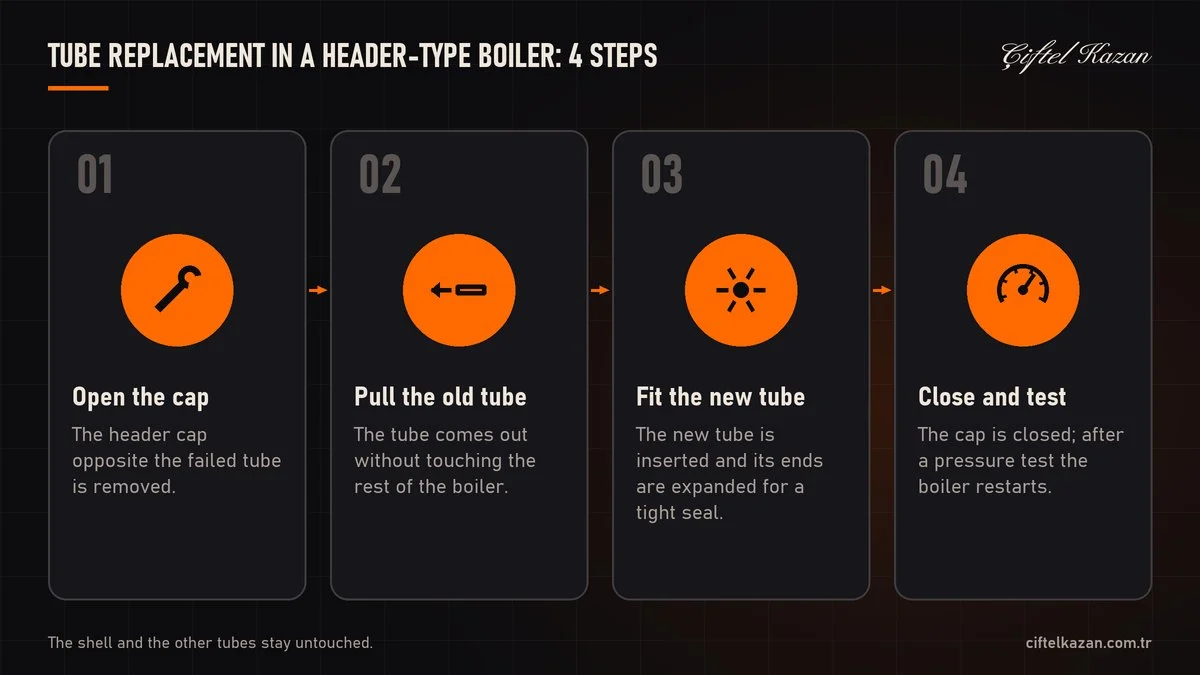
In a header-type boiler, the same failure is resolved much more simply. The header cover opposite the faulty tube is opened, and the old tube is removed. A new tube is inserted, and its ends are expanded with a mandrel to create a leak-proof connection to the header plate. The cover is closed, a pressure test is performed, and the boiler is put into operation. The boiler body, insulation, and other tubes are not touched.
If production needs to continue urgently, the faulty tube can still be quickly plugged through the header covers. However, plugging here is a temporary measure. The tube is replaced during the next convenient shutdown, and the boiler returns to its original heating surface. In other words, a header-type boiler is an asset that can be renewed, not one that is consumed over its lifespan. We have compiled the other advantages of the header-type design in our article 7 Advantages of Header-Type Boilers.
D-Type vs. Header-Type Boiler Comparison Table
| Criterion | D-Type Water-Tube Boiler | Header-Type Water-Tube Boiler |
|---|---|---|
| Tube geometry | Bent tubes between two drums; furnace walls are welded membranes | Straight tubes between front and rear header boxes |
| Intervention for faulty tube | In-situ replacement practically impossible; plugging from drum | Removed from cover and replaced; quick plugging if necessary |
| Intervention time | Long: cooling, draining, entering drum, repair | Short: on a per-tube basis, without touching the rest of the boiler |
| Effect of plugging | Permanent loss of heating surface and capacity | Temporary; surface returns to original state when tube is replaced |
| In-tube cleaning and inspection | Mostly chemical cleaning due to bends | Straight tubes; mechanical cleaning and visual inspection from cover |
| Typical fuel | Natural gas, liquid fuel (burner) | Coal and biomass (rotary grate) |
| Flame path | Combustion chamber + convection bundle | Four passes with 45° deflectors |
| Heat retention | Low water volume, heats up and cools down quickly | Refractory bricks + rock wool; retains heat for 24 hours |
| Capacity and pressure | High | Medium–high (field example: 25 t/h, 25 bar) |
| Adaptability to stop-start operation | Quick startup with gas | Direct restart with solid fuel due to heat retention |
| Lifetime maintenance cost | Failures accumulate, leading to major overhaul | Per-tube replacement, predictable maintenance |
Which is Better in Terms of Efficiency?
Both boilers operate at high efficiency when designed correctly. The difference emerges in maintaining that efficiency over the years. There are two major factors that reduce boiler efficiency: scale and soot buildup in the tubes, and loss of heating surface.
- Cleanability: The straight tubes of a header-type boiler can be mechanically cleaned and visually inspected through the covers. This is often not possible with the bent tubes of a D-type, requiring chemical cleaning.
- Surface loss: Each plugged tube in a D-type reduces the heating surface, increasing flue gas temperature and decreasing efficiency. In a header-type boiler, the tube is replaced, and the surface is preserved.
- Flame path: The four-pass flame circulation in a header-type boiler and refractory insulation ensure that heat remains within the boiler.
You can use our boiler efficiency calculator to see your boiler’s current efficiency.
How Does Fuel Choice Affect the Decision?
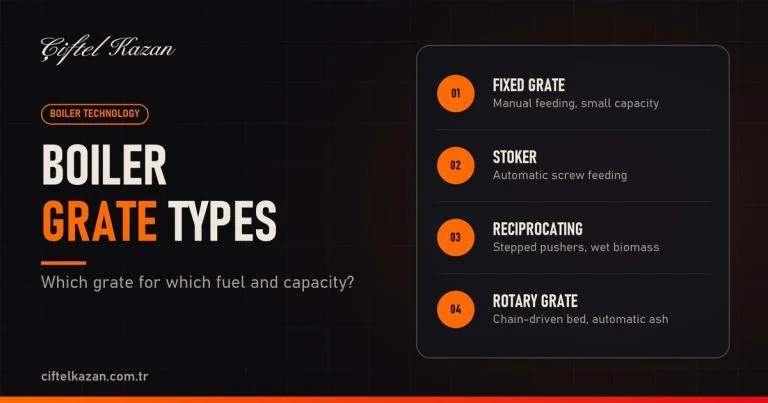
Fuel is one of the most decisive factors in this comparison. D-type boilers are designed for natural gas and liquid fuel applications operated with burners. Our header-type boilers, along with the rotary grate, are developed to burn solid fuels like coal and biomass automatically and efficiently.
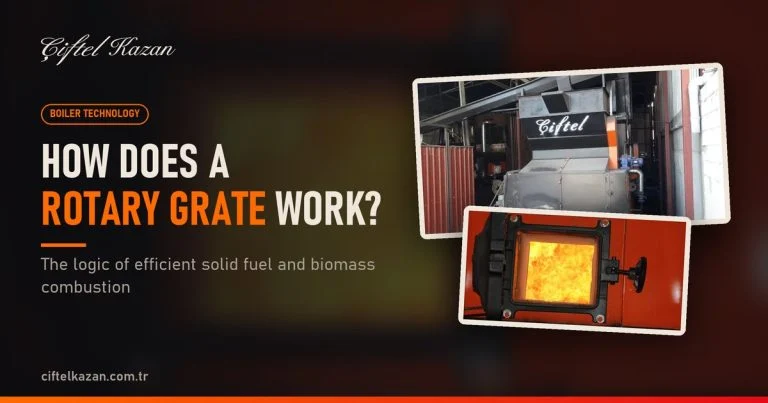
Fuel is the largest component of a steam boiler’s lifetime cost. Solid fuels and biomass can be more economical per unit of energy than natural gas in many regions. You can see the difference in your operation with your own figures using our fuel cost comparison tool. We explained the combustion logic of the rotary grate in our article How a Rotary Grate Works.
Which One for Which Operation?
Situations where you should choose a header-type boiler
- If you want to use solid fuels or biomass such as coal, hazelnut shells, pellets, or olive pomace.
- If you operate continuously where downtime is costly (dairy, food, vegetable oil, textile, pharmaceutical, poultry farming).
- If you plan to use the boiler for 20 years or more, maintaining efficiency through tube replacement.
- If you have variable steam demand and stop-start operation.
Situations where a D-type boiler excels
- If your fuel is exclusively natural gas or liquid fuel, and you need to fit very high capacity into a compact space.
- If there is no space in the boiler room for a solid fuel storage and ash removal system.
For operations running on natural gas at medium capacity, a natural gas fire-tube boiler is also a strong option. You can find all water-tube options together in our water-tube boiler guide.
From the Field: As a Manufacturer Producing Both Designs
One of our D-type boilers was manufactured for a university in Iraq. Our header-type boilers operate throughout Turkey:
- Akova Süt: 25 tons/hour and 25 bar.
- Özmiroğlu Yağ: 20 tons/hour and 12 bar.
- Many facilities such as Yonca Gıda, Verde Yağ, and Doğuş Süt.
Our field experience is clear: in operations using solid fuels and continuous production, the ease of tube maintenance is as important as capacity in boiler selection.
The header-type water-tube boiler and the rotary-grate combustion system are patented designs developed by Çiftel Kazan. We hold a total of 4 registered patents. You can see all our projects on our references page.
Before Deciding: Capacity and Water Quality
Whichever boiler you choose, two factors determine its lifespan: correct capacity and good water treatment.
- Capacity: An oversized boiler operates inefficiently at low loads, while an undersized boiler is constantly strained. You can perform a preliminary calculation of your needs with our steam boiler capacity calculator and review our capacity selection guide.
- Water quality: In water-tube boilers, the narrow tubes are sensitive to scale and oxygen corrosion. We addressed this issue in our article on boiler water treatment. For regular maintenance, you can also refer to our steam boiler maintenance checklist.
Conclusion: Two Boilers from the Same Family, a Different Lifespan
D-type and header-type boilers come from the same water-tube technology. However, they diverge when a tube failure occurs:
- In a D-type, a tube cannot be replaced in situ. A plugging process lasting days is required, and with each plugging, the boiler loses a bit more surface area.
- In a header-type boiler, tubes are individually and quickly replaced through the cover. The boiler returns to its original performance.
Therefore, for operations using solid fuels, continuous production, and aiming for a long lifespan, the choice often leans towards the header-type boiler.
Let’s evaluate which design is suitable for your facility, considering your steam demand, pressure, fuel, and installation space. Contact us or reach us at +90 232 479 11 21 / +90 544 479 11 21.
Frequently Asked Questions
Both are water-tube steam boilers. In a D-type boiler, bent tubes are connected to steam and water drums, and the furnace walls consist of welded membrane tubes. In a header-type boiler, straight tubes are expanded and connected to header boxes, and there is a maintenance cover opposite each tube. Therefore, tubes can be individually replaced in a header-type boiler.
It is practically impossible to remove and replace a single tube in situ. The tubes are bent and welded together in the furnace walls. In practice, the ends of the faulty tube are plugged from inside the drums. This process requires cooling, draining, and entering the drum, and usually takes days.
Plugging is the process of isolating a faulty tube by sealing its two ends with plugs. It allows the boiler to return to operation quickly, but the plugged tube is lost from the heating surface. As the number of plugged tubes increases, capacity and efficiency decrease. In a header-type boiler, plugging is a temporary measure; the tube is replaced later.
The header cover opposite the faulty tube is opened, and the old tube is removed. A new tube is inserted, and its ends are expanded with a mandrel to create a leak-proof connection to the header plate. The cover is closed, and a pressure test is performed. Since the boiler body and other tubes are not touched, the process takes much less time than plugging in a D-type.
A D-type boiler is suitable for facilities that will only use natural gas or liquid fuel and require very high capacity in a compact space. A medium-capacity natural gas fire-tube boiler can also be considered. If you are considering switching to solid fuel or biomass, a header-type boiler with a rotary grate is more advantageous in the long run.
Both boilers are designed to operate at high efficiency when new. The difference emerges over time. The straight tubes of a header-type boiler can be mechanically cleaned, and the heating surface is preserved by replacing faulty tubes. In a D-type, plugged tubes permanently reduce the surface area. Therefore, a header-type boiler maintains its efficiency better over the years.
Other Posts
All
Need a boiler or pressure vessel?
Let’s plan the best solution for your project together, backed by 40 years of engineering experience.