
Increasing Efficiency in Steam Boilers: 12 Methods to Reduce Fuel Bills
Not all of the fuel burned in a steam boiler is converted into steam. Some of it is lost through the chimney, some through blowdown, and some through boiler surface losses and leaks in steam lines.
Each of these losses directly impacts the fuel bill. The good news is: a significant portion of boiler efficiency improvement efforts do not require large investments.
In this article, we explain how boiler efficiency is measured, where energy is lost, and 12 practical methods to increase steam boiler efficiency. We have also provided links to relevant calculation tools for each method.
What is Boiler Efficiency and How is it Measured?
Boiler efficiency is the ratio of how much of the energy supplied to the boiler with fuel is transferred as useful heat to the steam. For example, in a boiler operating at 85% efficiency, 85 units of fuel energy are transferred to steam, while 15 units are lost through flue gas, unburned fuel, surface, and blowdown losses. Efficiency is measured by two methods: direct and indirect.
Direct method
The heat transferred to the steam is calculated from the steam flow rate, pressure, and feedwater temperature. The energy supplied is determined from fuel consumption and the calorific value of the fuel. The method is simple but highly dependent on the accuracy of the meters and does not show where the loss occurs.
Indirect (loss) method
Losses are determined individually and subtracted from 100. O₂, CO, and temperature in the flue gas are measured; unburned fuel in ash for solid fuels, as well as surface and blowdown losses are added. It is more useful in efficiency studies because it shows which item can be improved.
When making comparisons, pay attention to whether the efficiency is calculated based on the lower heating value or the higher heating value; the same boiler will give different results on two bases. For a quick calculation with your own values, you can use the boiler efficiency calculation tool.
Where is Energy Lost in a Steam Boiler?
The magnitude of losses varies depending on the fuel, boiler type, load, and maintenance status. Typical ranges are as follows:
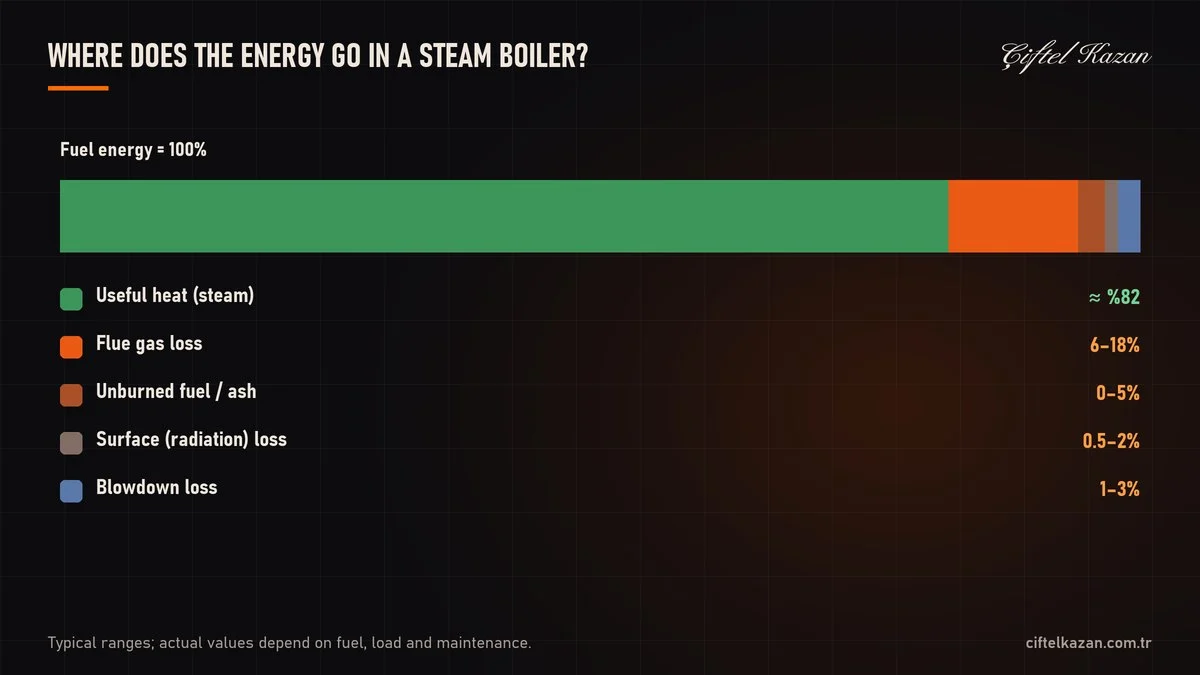
- Flue gas loss, 6–18%: This is the largest item. It is the heat lost with hot gases and excess air discharged from the chimney.
- Unburned fuel and ash loss, 0–5%: Especially in solid fuels, this is the fuel mixed with ash or discharged unburned.
- Surface (radiation) loss, 0.5–2%: This is the heat radiated from the boiler body to the environment; it increases proportionally at low loads.
- Blowdown loss, 1–3%: This is the heat lost with hot water discharged to limit the salt concentration in the boiler water.
In addition to these, there are distribution losses outside the boiler: uninsulated lines, steam leaks, faulty steam traps, and unreturned condensate. At Çiftel, we usually start with flue gas measurement when evaluating the efficiency of a plant; because it is the largest loss item and improvements with the fastest payback often come from here.
Improving Boiler Efficiency on the Combustion and Flue Gas Side
1. Optimize combustion settings (O₂, CO, and excess air coefficient)
Too much air increases the flue gas volume and carries heat out of the chimney. Too little air, on the other hand, produces CO, soot, and unburned fuel.
The goal is to operate at the lowest possible O₂ value while keeping CO low. In natural gas, this is usually around 2–3% O₂; in solid fuels, higher excess air is required depending on the fuel and grate. Proper combustion adjustment is one of the cheapest ways to save fuel.
The excess air coefficient (λ) is roughly estimated by 21 / (21 − O₂); 3% O₂ corresponds to approximately λ = 1.17. In rotary grates, under-grate air distribution and bed thickness directly affect this balance. You can see the loss with your current values in the flue gas loss calculation tool.
2. Continuously monitor flue gas temperature
An increase in flue gas temperature over time at the same load is the earliest sign of soot accumulation on the gas side or scale accumulation on the water side. According to a generally accepted rule of thumb, an increase of approximately 20 °C in flue gas temperature reduces boiler efficiency by roughly 1 point. Take the boiler’s clean condition value as a reference, and plan cleaning when you see a deviation. You can see the effect of these points on fuel with the boiler fuel consumption calculation tool.
3. Preheat feedwater with an economizer
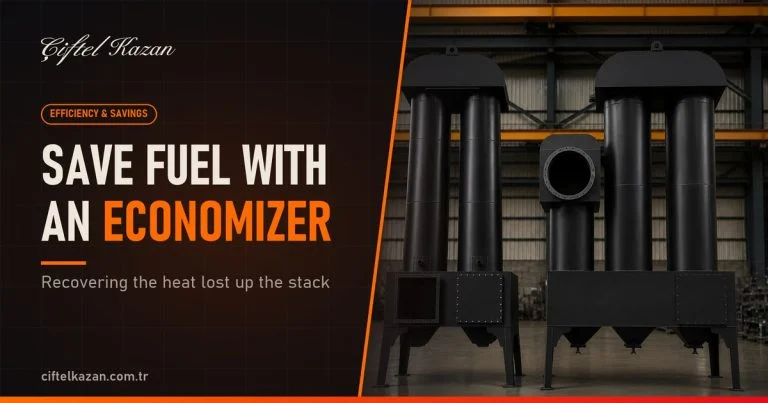
An economizer heats the feedwater entering the boiler with the heat of the gas going to the chimney. Flue gas temperature decreases, less fuel is burned for the same steam; the result is direct fuel savings. Suitability is evaluated based on flue gas temperature, sulfur and ash content of the fuel, and dew point corrosion limit. You can pre-evaluate the potential specific to your plant with the economizer savings calculation tool.
4. Preheat combustion air with a recuperator
A recuperator transfers the heat of the flue gas to the combustion air. Hot air accelerates combustion, supports furnace temperature especially in moist biomass, and reduces fuel consumption.
It is a complementary solution in systems where an economizer cannot be applied or where there is still recoverable heat after the economizer. The suitability of the burner or grate for hot air should be checked. For details, please refer to our recuperator page.
Maintaining Boiler Efficiency on the Water and Steam Side
5. Increase condensate return
Condensate is both hot and conditioned water. Every ton of condensate returned means savings in fuel, makeup water, chemicals, and blowdown. As a practical rule, every 6 °C increase in feedwater temperature provides approximately 1% fuel savings. You can see the value of unreturned condensate with the condensate recovery savings calculation tool.
6. Optimize blowdown and recover its heat
Excessive blowdown wastes water at saturation temperature. Insufficient blowdown, on the other hand, leads to foaming, carryover, and scaling. Conductivity (TDS) controlled automatic blowdown keeps the amount as needed.
Continuous blowdown water can be directed to a flash tank, and the resulting flash steam can be sent to the deaerator; the remaining hot water can preheat makeup water with a heat exchanger. You can find the correct blowdown ratio with the blowdown calculation tool.
7. Prevent scale with water treatment
Scale is a layer with very low thermal conductivity compared to steel. Even a thin layer of scale significantly reduces heat transfer, increases flue gas temperature, and leads to overheating of tube walls in water-tube boilers. Softening, deoxygenation, and regular water analysis are therefore directly related to boiler efficiency. For details, see our article on boiler water treatment, scale and blowdown.
Reducing Losses in the Distribution Line
8. Insulate pipes, valves, and flanges
Uninsulated steam and condensate lines, valve bodies, and flanges continuously lose heat. Insulation pieces not reinstalled after maintenance are also a common loss. Removable insulation jackets for valves and flanges reduce loss while maintaining ease of maintenance. You can see the loss of an uninsulated line with the pipe heat loss calculation tool.
9. Check for steam leaks and steam traps
A small steam leak, because it is continuous, turns into a large fuel loss throughout the year. An open steam trap leaks live steam. A closed steam trap, on the other hand, leads to condensate accumulation, water hammer, and reduced heat transfer.
Regular steam trap surveys and a leak repair list are among the fastest payback tasks. You can estimate the flow rate of the leak with the steam leak orifice flow rate calculation tool.
Improving Efficiency with Operation and Monitoring
10. Match boiler capacity to load, reduce on-off cycles
A boiler selected larger than needed operates at low load and cycles on and off frequently. In burner-fired boilers, pre-purge air cools the boiler at each shutdown; the share of surface loss also increases at low loads. Staged operation and load sharing in multi-boiler plants reduce these losses.
Çiftel’s header-type boilers can maintain their heat for 24 hours with firebrick and rock wool insulation, so reheating loss remains limited in on-off operating plants. Check your needs with the steam boiler capacity calculation tool.
11. Select operating pressure according to the process
Operating at a pressure higher than required by the process means a higher saturation temperature. Surface loss, steam escaping from leaks, and flash steam from condensate increase. Keeping the pressure as needed provides a small but continuous gain.
However, operating the boiler much below its design pressure can lead to wet steam, so the decision should be made with the manufacturer. You can examine the pressure-temperature relationship from our saturated steam table tool.
12. Train operators, continuously measure and monitor
Permanent boiler efficiency is measured and monitored efficiency. Regular recording of steam and fuel meters, flue gas analyzer, feedwater and condensate temperatures, and blowdown amount catches deviations early. Even daily monitoring of a simple indicator like the steam/fuel ratio tells a lot.
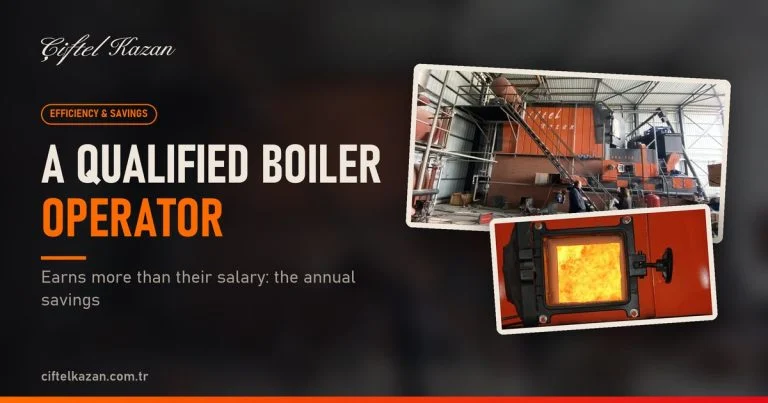
A trained operator interprets this data and maintains combustion settings. We covered this topic in our article on the contribution of a qualified boiler operator to the operation.
How Much Does Each Method Save?
The table below summarizes the typical effect and investment level of boiler efficiency improvement methods. The values are generally accepted ranges. Actual gains depend on the current condition of the boiler and should be verified by measurement on a plant-specific basis.
| Method | Typical effect | Investment level |
|---|---|---|
| 1. Combustion adjustment | Generally 1–3% | Low |
| 2. Monitoring flue gas temperature | Catches fouling early; approx. 20 °C ≈ 1 point | Low |
| 3. Economizer | Generally 2–5% | Medium |
| 4. Recuperator | Depends on flue gas temperature; complements economizer | Medium |
| 5. Condensate return | Every 6 °C feedwater increase ≈ 1%; also water and chemical savings | Medium |
| 6. Blowdown optimization and heat recovery | A significant portion of 1–3% blowdown loss can be recovered | Low–Medium |
| 7. Water treatment | Prevents scale-related efficiency drop and tube damage | Low–Medium |
| 8. Insulation | High in uninsulated lines; payback usually short | Low |
| 9. Leak and steam trap maintenance | Depends on the number of leaks; often the fastest payback task | Low |
| 10. Capacity matching | Reduces on-off and low load losses | Between Low (operation) and High (new boiler) |
| 11. Correct operating pressure | Small but continuous gain | Very Low |
| 12. Operator training and monitoring | Ensures the permanence of other gains | Low–Medium |
The effects are not additive. For example, after combustion adjustment, the flue gas temperature drops, so the additional gain from an economizer also changes. Therefore, it is necessary to measure first, then prioritize.
Conclusion: Efficiency is a Habit, Not a Project
Start boiler efficiency improvement efforts with measurement. Flue gas analysis and steam/fuel ratio will tell you where to start.
Low-cost tasks such as combustion adjustment, leak repair, and insulation are often the first step. Investments such as economizers, recuperators, and condensate return provide permanent fuel savings. For basic concepts, you can also check our steam boiler guide.
As Çiftel Kazan, we have been designing and manufacturing steam boilers, economizers, and recuperators since 1986. To evaluate the efficiency of your boiler room together, contact us or reach us at +90 232 479 11 21 / +90 544 479 11 21.
Frequently Asked Questions
There is no single correct value for steam boiler efficiency; the result depends on the fuel, boiler type, load profile, and which heating value the efficiency is calculated against. Generally, boilers with heat recovery and good adjustment achieve higher values. For example, Çiftel’s hybrid boiler operates with over 90% thermal efficiency. Regularly measuring your own boiler with the same method is more meaningful than a one-time value.
The fastest results usually come from combustion adjustment, fixing steam leaks, and replacing faulty steam traps. These tasks are done with low investment, and their effect is seen in fuel consumption in a short time. Investments such as economizers, condensate return lines, or recuperators provide larger but planning-intensive gains.
The appropriate flue gas temperature depends on the boiler type, fuel, and heat recovery equipment; therefore, the boiler’s clean condition value should be taken as a reference. An increase in this value at the same load is a sign of fouling. There is also a lower limit: if the flue gas falls below the dew point, there is a risk of acid corrosion, especially with sulfur-containing fuels.
An economizer can be added to most steam boilers, but suitability should be evaluated on a plant-specific basis. Flue gas temperature, sulfur and ash content of the fuel, available space, and feedwater temperature are determining factors. For solid fuel boilers, a cleanable design against ash accumulation is important. You can pre-evaluate the savings potential with the economizer savings calculation tool.
The water discharged from the boiler during blowdown is at saturation temperature, and the heat within it is lost along with it. If blowdown is excessive, energy, water, and chemicals are wasted. If it is insufficient, dissolved salts accumulate; foaming, carryover, and scaling begin. Conductivity-controlled automatic blowdown and heat recovery with a flash tank establish this balance.
O₂, CO, and temperature values in the flue gas should be monitored continuously or at least weekly. A comprehensive efficiency measurement, on the other hand, should generally be done after maintenance, when fuel changes, and when the load profile changes. Daily recording of the steam/fuel ratio is the cheapest way to catch deviations between two measurements.
Other Posts
All
Need a boiler or pressure vessel?
Let’s plan the best solution for your project together, backed by 40 years of engineering experience.