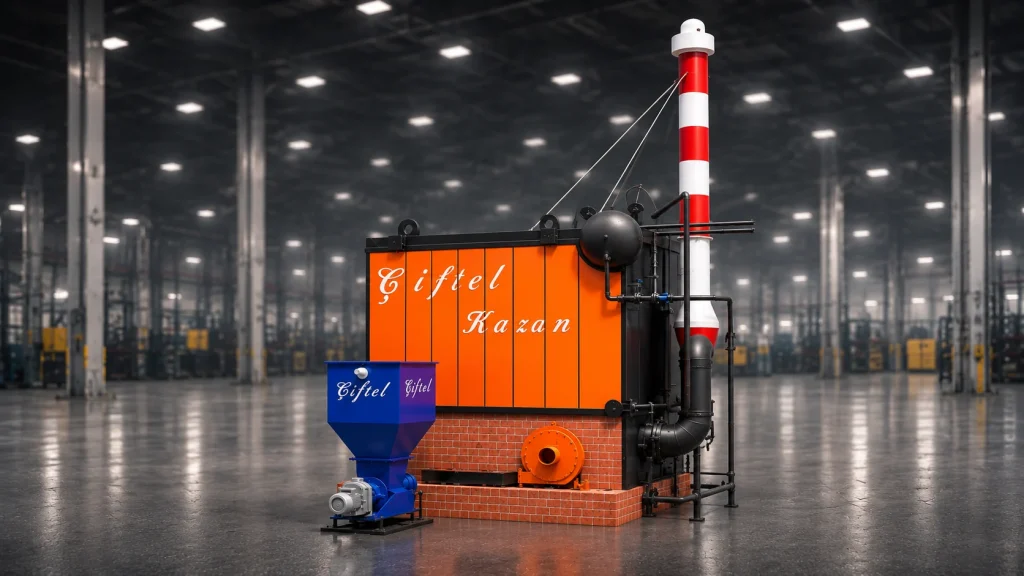
A water-tube boiler is a type of boiler in which water circulates through tubes, while combustion gases pass around the outside of these tubes to transfer heat. Water-tube steam boilers are preferred in industrial facilities that require high pressure, high capacity, and rapid steam production. Çiftel Kazan has been designing and manufacturing water-tube steam boilers—combined with rotary grate technology—in Izmir since 1986.
How does a water-tube boiler work?
The upper section of the boiler contains the steam drum (steam tank), while the lower section contains water distribution manifolds or the water drum. Numerous tubes connecting these sections are arranged around the furnace and flue gas passages. The heat from the fuel burning in the furnace heats the water in the tubes; the heated water-steam mixture rises as its density decreases, while cold water flows down through the downcomers. Thanks to this natural circulation, the water circulates continuously, and the steam separates in the steam drum before being sent to the facility.
Since the volume of water inside the tubes is small, the boiler comes online quickly and responds rapidly to load changes. The large, water-cooled combustion chamber allows for the complete combustion of solid fuels, such as coal and biomass, on a rotary grate or stoker.
The Difference Between a Water-Tube Boiler and a Scotch (Fire-Tube) Boiler
| Criterion | Water-tube boiler | Scotch-type boiler |
|---|---|---|
| Circulation | Water in the tubes, gas outside | Gas in the tubes, water in the shell |
| Pressure / capacity | Suitable for high pressure and capacity | Typically for low to medium pressure and capacity |
| Commissioning | Fast | Slower due to the large volume of water |
| Safety | Water under pressure is distributed through small-diameter tubes | A large volume of water is pressurized within a single shell |
| Solid fuel | Wide firebox; very suitable for a rotary grate and stoker | A pre-furnace must be added for solid fuel |
| Load fluctuations | Balanced by the control system | Large water volume acts as a natural buffer |
You can also check out our article “Scotch Boiler or Water-Tube Boiler?” where we explain step by step which one is right for your business.
Advantages of a water-tube steam boiler
- High pressure and capacity: The small pipe diameters make the high-pressure design cost-effective.
- Rapid steam production: Thanks to the small water volume, the boiler reaches operating pressure quickly.
- Suitability for solid fuel: The water-cooled, wide firebox ensures continuous and balanced combustion with coal and biomass.
- Safe design: Since the pressurized water is distributed across numerous tubes, it offers safer operation compared to fire-tube boilers.
- Flexible installation: Modular and packaged designs can be adapted to different boiler room dimensions.
Feedwater quality is even more critical in water-tube boilers: scale and oxygen quickly cause problems in the tubes. Therefore, water softening, deaeration, and regular blowdown are integral parts of the design.
Çiftel Kazan water-tube boiler models
Header-type water-tube steam boiler with rotary grate
Developed for high capacity and continuous steam demand, the header-type water-tube boiler utilizes a four-pass flame circulation system and an automatic combustion system with a rotary grate to utilize coal and biomass in the most economical manner. Firebrick and rock wool insulation minimize heat loss. Advantages of the header-type boiler
Packaged Water-Tube Steam Boiler
The packaged-type boiler is a compact redesign of the header-type water-tube boiler. With its vertical water-tube structure, it can be connected to a stoker or a rotary grate solid fuel system with one or two steam drums depending on capacity, making it suitable for small- and medium-capacity facilities.
Hybrid water-tube steam boiler
The hybrid boiler combines a top-mounted Scotch-type three-pass shell with a water-tube radiation section at the bottom. It can operate with solid, liquid, or gaseous fuels; its thermal efficiency exceeds 90%.
Stoker-Fired Water-Tube Boiler
In a stoker-fired water-tube boiler, coal and biomass are fed into the furnace at a steady rate via a screw conveyor. It is an economical, fully automatic solution for small and medium-capacity applications.
Type D water-tube boiler
This is a compact, high-capacity water-tube boiler design in which the upper steam drum and lower water drum are connected by tubes arranged in a “D” shape. For details, see our D-type boiler guide.
In which facilities are water-tube boilers used?
The primary applications for water-tube steam boilers include the production of milk and dairy products, canned goods, tomato paste, oil, and sugar; textile dyeing plants; lumber, wood, and particleboard manufacturing; paper and packaging; chemical and pharmaceutical facilities; and district heating and power plants. In particular, facilities with continuous and high steam consumption where solid fuel is cost-effective benefit the most.
Çiftel Kazan holds 4 registered patents—including for a combustion system and a multi-pass water-tube boiler with a rotary grate—has completed over 1,250 projects, and maintains a 24/7 service network throughout Turkey.