
Thermal Oil Boiler or Steam Boiler? The Right Choice for Your Process
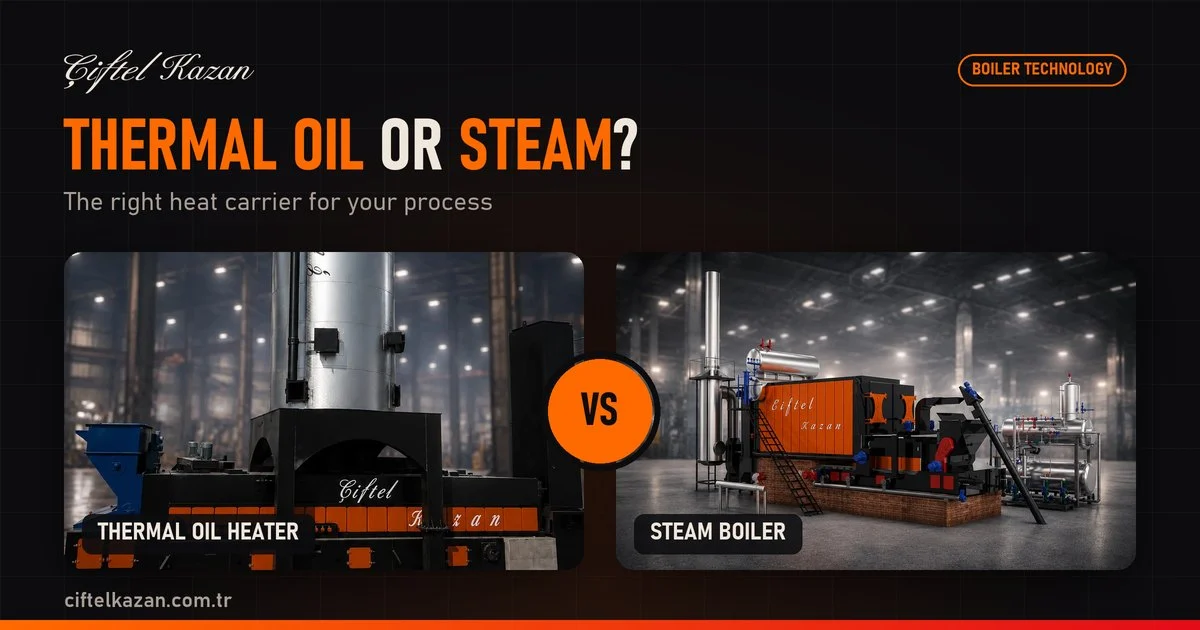
The two most common methods of heat transfer in industrial processes are steam and thermal oil systems. Both transfer heat generated in a boiler to consumers; however, their operating principles, the temperatures they can reach, and their operational requirements differ significantly. The wrong choice can result in unnecessarily high pressure, high operating costs, or process issues.
How Does a Steam System Work?
Water is vaporized in a steam boiler; as the steam travels to the consumer and condenses, it releases its latent heat. Because the heat released during condensation is very high, steam transfers a great deal of heat with a small mass and transfers heat to surfaces very efficiently.
A key characteristic of steam is that its temperature depends on pressure. Approximate values for saturated steam are as follows:
| Steam temperature | Required pressure (absolute, approximate) |
|---|---|
| 180 °C | 10 bar |
| 250 °C | 40 bar |
| 300 °C | 86 bar |
In other words, when high temperatures such as 250–300 °C are to be achieved using steam, a very high-pressure system—and a correspondingly expensive one—is required.
How Does a Thermal Oil System Work?
A special heat transfer oil is heated in a thermal oil boiler and circulated to consumers in a closed loop via pumps. The oil transfers its heat without changing phase (without vaporizing) and returns to the boiler. Depending on the type, heat transfer oils can operate at temperatures up to approximately 300 °C under low pressure. System pressure is determined not by temperature, as is the case with steam, but solely by the pump and circuit design.
Comparison Table
| Criterion | Steam | Thermal Oil |
|---|---|---|
| High temperature (above 250 °C) | Requires very high pressure | Possible at low pressure |
| Heat transfer | Very efficient due to condensation | Lower; requires a larger heat exchanger surface area |
| Water treatment | Required | Not required |
| Condensate and steam traps | Present | None |
| Corrosion and freezing | Requires caution | Low risk in closed systems |
| Direct use (sterilization, humidification) | Possible | Not possible |
| Fluid maintenance | Water quality monitoring | Periodic oil analysis and replacement as needed |
| Risk in the event of a leak | Hot steam and water | Flammable fluid; fire prevention measures are essential |
Which One in Which Situation?
Steam may be more suitable if:
- Your process temperatures are generally below 200 °C,
- You are using steam directly (sterilization, cooking, humidification, steam injection),
- You have a large number of dispersed consumers,
- You operate in an industry where steam is widely used, such as dairy, food, pharmaceuticals, and textile dyeing.
Thermal oil may be more suitable if:
- The process requires precise and stable temperatures in the 200–300 °C range,
- You do not want to install and operate a high-pressure steam system,
- You have high-temperature indirect heating applications such as textile stenter machines, presses, reactors, or frying,
- You do not want to deal with water treatment and condensate systems.
In some facilities, both systems are used together: Lines requiring high temperatures are supplied with thermal oil, while other consumers are supplied with steam.
Basic Components of a Thermal Oil System
- Thermal oil boiler: The coiled tubes through which the oil flows are heated by combustion heat.
- Circulation pumps: These continuously circulate the oil between the boiler and the consumers. Ensuring that the flow of oil through the boiler is uninterrupted is critical to preventing the oil from overheating.
- Expansion tank: As the oil heats up, its volume increases; the expansion tank accommodates this volume change and helps remove air and moisture from the system.
- Drain and storage tank: Ensures that oil can be safely drained from the system during maintenance.
- Safety equipment: Flow, temperature, and level safety devices shut down the burner or combustion system in the event of an abnormal condition.
Two issues are particularly important during operation: When the system is first commissioned, moisture in the oil must be removed in a controlled manner, and the boiler must never be fired without oil flow. Regular oil analysis is key to the system’s long-term operation.
For Lower Temperatures: Hot Water and Superheated Water
Hot water boilers can be considered for heating and process needs around 100 °C, while superheated water boilers can be considered for systems that use water under pressure at temperatures above 100 °C.
Let’s Evaluate Your Boiler Room Together
As Çiftel Kazan, we have been manufacturing steam, thermal oil, and hot water boilers at our facility in Kemalpaşa, Izmir, since 1986. Contact us or reach out via the +90 232 479 11 21 / +90 544 479 11 21 numbers to jointly assess the current status of your boiler room and discuss what can be done to improve efficiency and reduce costs.
Frequently Asked Questions
The boiling point of the heat transfer oil is very high; the oil remains liquid at operating temperatures. Therefore, system pressure is determined not by temperature, but by the pump and circuit design.
The oil’s service life depends on the operating temperature, system design, and operating conditions. Periodic oil analysis is the most accurate way to monitor the oil’s condition and determine when to replace it.
Both systems have their own specific risks. Thermal oil systems operate at low pressure, but since the oil is flammable, leak and fire prevention measures are critical. In steam systems, pressure and hot water risks must be managed. With proper design and maintenance, both can be operated safely.
It may be possible; however, the heat exchangers must be compatible with thermal oil. This conversion should be evaluated on a case-by-case basis.
You can explore our thermal oil boilers and our entire product line.
Other Posts
All


Need a boiler or pressure vessel?
Let’s plan the best solution for your project together, backed by 40 years of engineering experience.