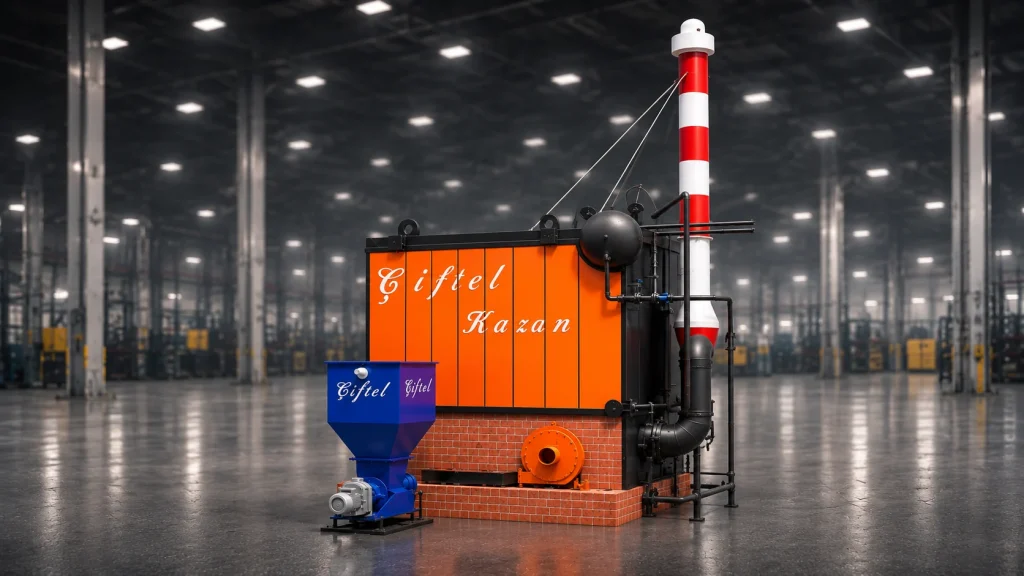
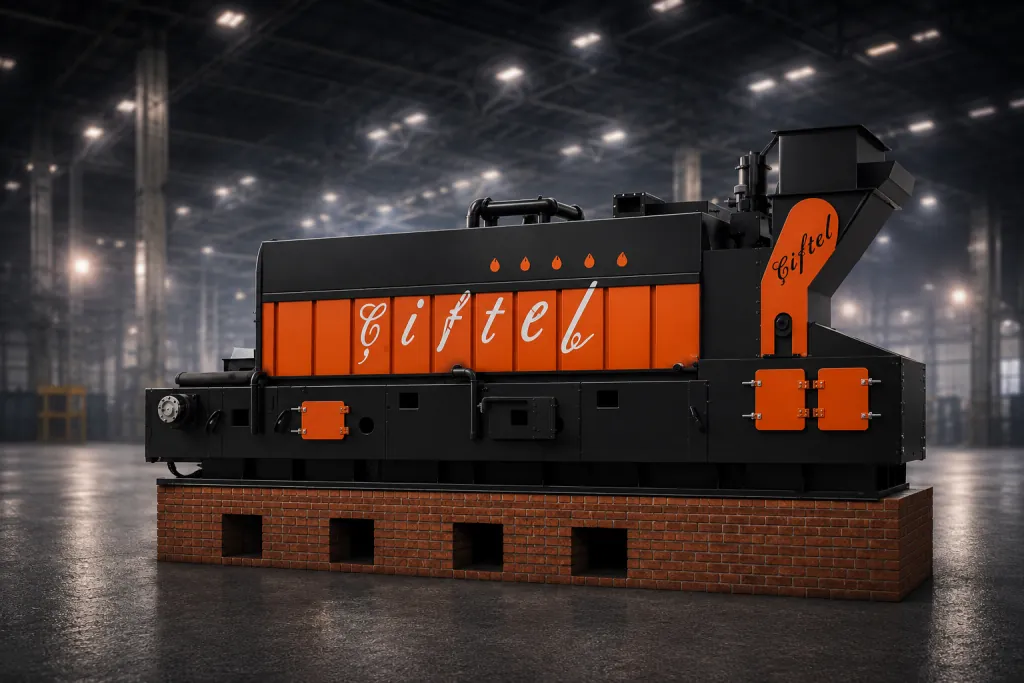
A coal-fired boiler is an industrial boiler that produces steam, hot water, superheated water, or thermal oil by burning solid fuels such as coal and biomass. A coal-fired steam boiler equipped with the right combustion system significantly reduces operating costs in facilities where fuel costs are a major factor and where steam is consumed continuously. Çiftel Kazan, which holds two registered patents in solid fuel combustion technology, has been manufacturing rotary grate water-tube coal-fired boilers in Izmir since 1986.
Why choose a coal-fired or solid-fuel boiler?
- Low fuel cost: In many regions, coal and biomass are more economical per unit of heat than natural gas and liquid fuels.
- Fuel supply security: Storable solid fuel safeguards production against gas outages.
- Waste utilization: Production waste such as sawdust, olive pomace, and hazelnut and sunflower shells can be used as biomass fuel.
- Long service life: Water-tube, wide-firebox designs can handle the load of solid fuel for many years.
How does a coal-fired steam boiler work?
Coal is automatically fed from the bunker onto the grate; the fuel burns in a layer with air supplied from beneath the grate. The resulting hot gases pass through the water-cooled combustion chamber and the boiler’s tube bundles, transferring their heat to the water. Ash and slag are automatically discharged at the end of the grate. To ensure balanced combustion, the fuel feed rate, air supply, and grate speed are controlled together.
Rotary grate and stoker: which combustion system?
Rotary grate combustion system
A solid fuel combustion system with a rotary grate consists of a chain-driven grate made of heat-resistant, specially alloyed cast plates. A helical feeder and a guillotine rake spread the fuel onto the grate in a uniform layer; as the grate advances, the fuel burns completely and the ash is automatically discharged. It is ideal for medium- and high-capacity, continuously operating boilers. We explained the operating principle in our article on rotary grates.
Stoker (screw) feeding
In stoker-fired boilers, fuel is conveyed directly to the combustion zone via a screw conveyor. This is a simpler and more economical system; it is preferred for small and medium capacities.
| Criteria | Rotary grate | Stoker |
|---|---|---|
| Suitable capacity | Medium–high | Small–medium |
| Fuel flexibility | Coal and various types of biomass | Coal and appropriately sized biomass |
| Ash removal | Continuous, automatic via grate movement | Automatic |
| Investment | Higher | Lower |
Çiftel Kazan coal-fired boiler models
- Header-type water-tube rotary grate steam boiler: four-pass design for high capacity and continuous steam.
- Packaged water-tube boiler: a compact boiler that can be connected to a stoker or rotary grate.
- Hybrid steam boiler: a design with over 90% efficiency capable of operating with liquid and gas fuels in addition to solid fuel.
- Stoker-fired water-tube boiler: a fully automatic, economical solution for small and medium capacities.
- Solid-fuel thermal oil, hot water, and superheated water boilers: Can operate in conjunction with a rotary grate system.
Converting an existing natural gas boiler to coal
It is possible to switch a boiler that runs on natural gas or liquid fuel to solid fuel without having to replace it. A burner-type pre-furnace is a water-cooled combustion chamber mounted in front of the boiler; when combined with a rotary grate combustion system, it enables the existing boiler to operate on coal and biomass. It is most commonly applied to Scotch-type boilers. Details: Converting an existing boiler to solid fuel.
Efficiency, Emissions, and Operation
The primary factors determining efficiency in a coal-fired boiler are complete fuel combustion, proper excess air, clean heat transfer surfaces, and the recovery of waste heat from flue gases. Automatic fuel feeding and ash removal reduce the operator’s workload while maintaining stable combustion; economizers and recuperators increase efficiency. The need for flue gas treatment (such as cyclones or filters) is determined in the project based on the fuel type and applicable emissions regulations.
Çiftel Kazan’s combustion system and multi-pass water-tube boiler with a rotary grate constitute two of our four registered patents. Our boilers operate with thermal efficiencies ranging from 85% to 95%, depending on the boiler type, fuel, and operating conditions.