
Header-Type Water-Tube Steam Boiler: Çiftel’s Patented Design and 7 Advantages
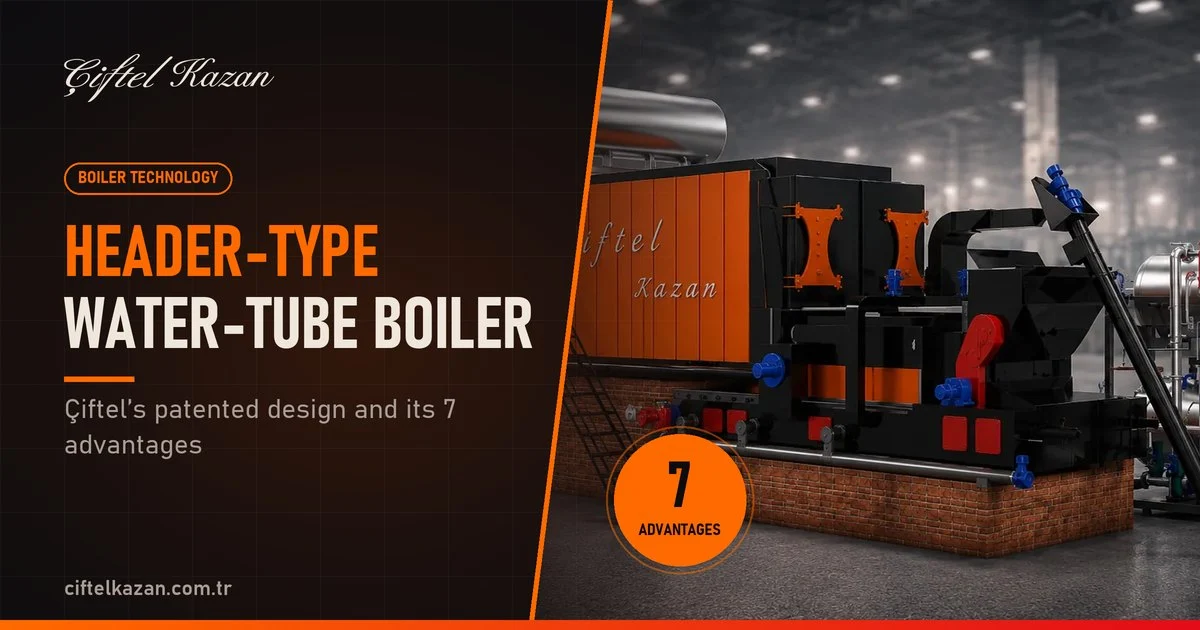
Water-tube steam boilers are the preferred choice for facilities with high steam demand due to their high pressure, high capacity, and safety advantages. However, traditional water-tube designs have a well-known challenge: Replacing tubes that wear out over time can be a lengthy and costly process. Çiftel Kazan’s header-type water-tube steam boiler was developed specifically to address this issue during the design phase.
First, a Quick Overview: How Does a Water-Tube Boiler Work?
In a water-tube boiler, water circulates inside the tubes, while hot combustion gases heat the tubes from the outside. Small-diameter tubes withstand high internal pressure much better than large shells, and there is no large volume of pressurized water inside the boiler. In this article, we’ve compared its differences with fire-tube (Scotch-style) boilers in detail.
What Is a Header-Type Design?
A “header” is the collector (distributor) to which the tubes are connected. In a header-type design, the boiler tubes are connected to the headers at both ends; water and steam are distributed and collected through these headers. The most important result of this structure is that the tubes can be removed and replaced individually.
When a tube wears out over time, there is no need to overhaul a large portion of the boiler; only the affected tube is replaced. The main body and header structure remain in place, and the boiler returns to near-original performance with the tube replacement.
7 Advantages of a Header-Type Water-Tube Boiler
1. Easy and quick tube replacement
The ability to replace tubes individually significantly reduces maintenance time and costs. Downtime is minimized, and the production schedule is less affected.
2. Long-lasting investment
Since the boiler’s framework remains intact while the tubes can be replaced, the boiler transforms from a depreciating asset into a renewable one. This preserves the value of the investment in the long term.
3. Safety
Water is present in small volumes within the tubes. The energy that could be released in the event of a failure is much lower than in large-body boilers. For this reason, water-tube boilers are considered safe in terms of explosion risk.
4. High Pressure and High Capacity
The water-tube design can operate safely at high pressures and capacities. Among the header-type boilers we supply are systems operating at 25 bar pressure and a capacity of 20–25 metric tons per hour.
5. Rapid startup and load tracking
Thanks to the low water volume, the boiler transitions from cold to steam in a shorter time and responds more quickly to changes in steam demand.
6. Full compatibility with the rotary grate
We design our header-type boilers in conjunction with our patented rotary grate combustion system. This ensures that solid fuels, such as coal and biomass, are burned automatically, continuously, and efficiently. We explained how the rotary grate works in this article.
7. Project-specific design flexibility
The header-type structure can be adapted to different designs based on the facility’s layout and requirements. For example, the boiler we manufactured for Royal İlaç was built as a two-story custom design with a capacity of 20 metric tons per hour and a pressure of 25 bar.
A Patented Çiftel Design
The header-type water-tube boiler system and the rotary grate combustion system are patented designs developed in-house by Çiftel Kazan. We carry out all stages—from design to manufacturing—at our facility in Kemalpaşa, İzmir.
Field Examples
| Company | Capacity | Pressure | System |
|---|---|---|---|
| Akova Süt (Konya) | 25 metric tons/hour | 25 bar | Water-tube header type |
| Royal İlaç | 20 metric tons per hour | 25 bar | Water-tube header type with rotary grates, two-story |
| Özmiroğlu Yağ | 20 metric tons per hour | 12 bar | Water-tube header-type rotary grate |
| Yonca Gıda | 15 metric tons per hour | 12 bar | Water-tube header-type rotary grate |
| Verde Yağ | 12 metric tons per hour | 12 bar | Water-tube header-type with rotary grate |
| Orkide (Kemalpaşa) | 6 metric tons per hour | 12 bar | Rotary grate header type + economizer |
You can view all our projects on our References page.
Which Industries Is It Suitable For?
The header-type water-tube boiler is a powerful solution for industries with continuous and high steam demand—such as dairy and dairy products, food, vegetable oil, textiles, pharmaceuticals, poultry, and animal feed—especially for businesses looking to use solid fuel or biomass. You can consult our capacity selection guide to determine the correct capacity.
Let’s Evaluate Your Boiler Room Together
As Çiftel Kazan, we have been manufacturing steam, thermal oil, and hot water boilers at our facility in Kemalpaşa, İzmir, since 1986. Contact us or reach out via the numbers +90 232 479 11 21 / +90 544 479 11 21 to assess the current condition of your boiler room together and discuss what can be done to improve efficiency and reduce costs.
Frequently Asked Questions
In both types, water circulates through the tubes. In a header-type design, the tubes are connected to collectors at both ends, so they can be replaced individually; this simplifies maintenance and extends the boiler’s lifespan.
The time depends on the number of tubes to be replaced and the boiler’s construction. However, since it is not necessary to disassemble a large portion of the boiler, the process is completed much more quickly than with conventional designs.
It operates with solid fuels such as coal and biomass using a rotary grate combustion system. Depending on the project, other fuel options may also be considered.
Scale and corrosion in the fine tubes reduce heat transfer and can lead to tube damage. While the header-type design facilitates tube replacement, proper water treatment is always essential. For more details, please refer to our article on water treatment.
Other Posts
All
Need a boiler or pressure vessel?
Let’s plan the best solution for your project together, backed by 40 years of engineering experience.