
Biomass Boiler: Steam Production from Hazelnut Shells, Pellets, Olive Pomace and Sawdust
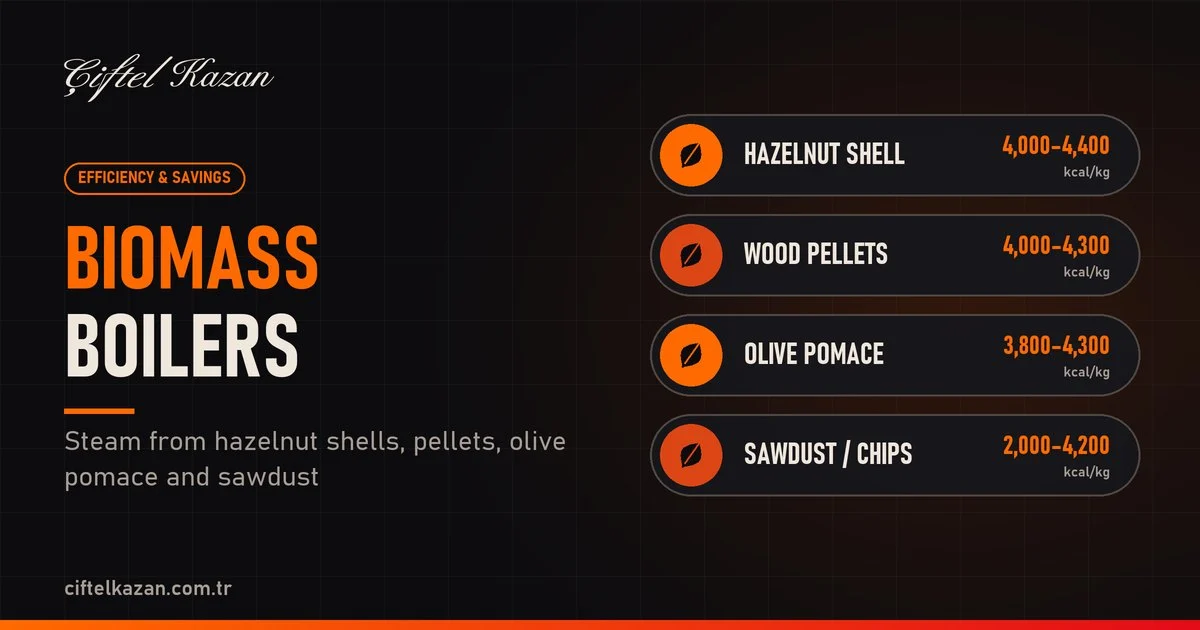
Hazelnut shells, olive pomace, pellets, or sawdust: in many industrial regions, these fuels are either a byproduct of production or a resource readily available in the vicinity. A properly designed biomass boiler converts these fuels into an economical and continuous source of steam. However, not all biomass burns the same way; moisture, ash content, and volume directly influence boiler design.
In this article, we compare the typical calorific value, moisture, and ash content of the most common biomass fuels, and discuss slagging and corrosion risks, storage and feeding, how the rotary grate is sized for the fuel, and the economic aspects.
What is a Biomass Boiler?
A biomass boiler is a boiler that produces steam, superheated water, or hot water by burning fuels of plant origin such as hazelnut shells, wood pellets, olive pomace, sawdust, and sunflower husks. In industry, a water-tube boiler is typically used with a combustion system that automatically feeds the fuel and automatically discharges ash, often in conjunction with a rotary grate.
Biomass fuel consists of residues from the agricultural, food, and forest products industries, or pellets produced for this purpose. It has a lower calorific value and a higher volatile matter content compared to coal. Therefore, more fuel mass, larger storage volume, and a fuel-specific combustion setup are required for the same amount of steam. The main task in biomass steam boiler design is to adapt the boiler to the fuel. We explained how the rotary grate feeds, burns, and discharges ash from biomass in our article How Does a Rotary Grate Work.
Comparison of Biomass Fuels: Calorific Value, Moisture, and Ash
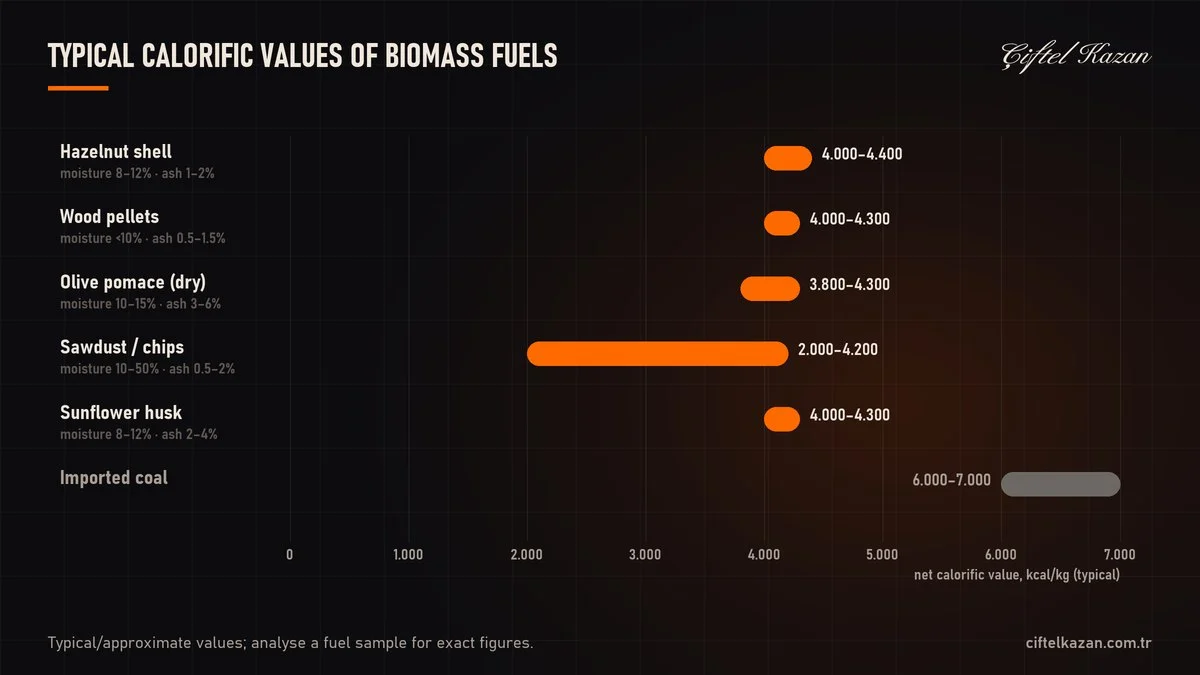
The table below shows the typical values of the most frequently encountered biomass fuels in industry, along with imported coal for comparison.
| Fuel | Lower Heating Value | Moisture | Ash |
|---|---|---|---|
| Hazelnut shell | 4,000–4,400 kcal/kg | 8–12% | 1–2% |
| Wood pellet | 4,000–4,300 kcal/kg | Below 10% | 0.5–1.5% |
| Olive pomace (dried, de-oiled) | 3,800–4,300 kcal/kg | 10–15% | 3–6% |
| Sawdust / Wood chip | 2,000–4,200 kcal/kg (depends on moisture) | 10–50% | 0.5–2% |
| Sunflower husk | 4,000–4,300 kcal/kg | 8–12% | 2–4% |
| Comparison: Imported coal | Typical 6,000–7,000 kcal/kg | Varies by type | Varies by type |
Note: The values in the table are typical/approximate ranges and vary depending on the fuel source, season, and storage conditions. A sample analysis is essential for exact values. At Çiftel, we require an analysis of the fuel to be used before starting a biomass project.
Hazelnut Shell
Being dry, hard, and low in ash, it is one of the most trouble-free biomass fuels. Its free-flowing nature facilitates screw feeding. The main issue for a hazelnut shell boiler is the seasonality of supply and the planning of storage space to last throughout the year.
Wood Pellet
With its standard size, low moisture, and high density, it is the easiest biomass to operate. Pellet boilers work smoothly with stokers in small capacities and with rotary grates in large capacities. As it is a processed fuel, its unit energy cost is generally higher than that of residual fuels.
Olive Pomace
It is a residue from olive oil production; dried and de-oiled olive pomace has a good calorific value. Due to its relatively high ash content, ash discharge capacity and slagging tendency must be considered. In the design of boilers burning olive pomace, the variation in moisture from batch to batch is also taken into account.
Sawdust and Wood Chips
These are residues from the forest products and furniture industries. Their calorific value largely depends on moisture: dry sawdust burns well, while the calorific value of wet chips can drop by half. For boilers burning sawdust, storage volume and bridging in the bunker must be considered separately due to the light and fibrous structure.
Sunflower Husk
It is a residue from the sunflower oil industry; it is dry and has a high calorific value. Its ash content is higher than that of hazelnut shells, and some batches may exhibit a tendency for the ash to soften at low temperatures. Therefore, bed temperature and air distribution become important.
Why is the Relationship Between Moisture and Calorific Value So Important?
Water in fuel does not burn; on the contrary, it consumes the fuel’s own energy to evaporate. Therefore, as moisture increases in biomass, the lower heating value decreases significantly. The sawdust row in the table clearly shows this: while the same sawdust can exceed 4,000 kcal/kg in dry form, it drops to around 2,000 kcal/kg in very moist form.
This has three effects on operation:
- More Fuel: Fuel consumption for the same amount of steam can nearly double; the feeding and ash system also scale up accordingly.
- More Flue Gas: Evaporating water increases flue gas volume; fans and gas paths handle a larger volume, and heat loss with flue gases increases.
- Lower Furnace Temperature: Combustion cools down, ignition becomes difficult, and the drying zone on the grate lengthens.
The practical consequence is: store fuel in a covered and ventilated area if possible, and agree on a moisture limit with the supplier. You can see the cost of moisture for yourself by experimenting with different calorific values in the boiler fuel consumption calculator.
Ash Melting Point, Slagging, and Corrosion
A significant portion of operational problems in biomass boilers stems from the behavior of the ash. The ash content of biomass is generally lower than that of coal; however, the behavior of the ash is as important as its quantity. The ash melting point is the temperature at which the ash softens, melts, and becomes sticky. If the bed temperature approaches this value, the ash will form slag, block the air gaps of the grate, and combustion will be locally impaired.
In some agricultural residues, alkali metals such as potassium, as well as chlorine, may be higher. These components can lead to sticky deposits on the boiler’s heat transfer surfaces, causing fouling and, in the long term, corrosion. The main preventive measures are:
- Requesting the ash melting temperature and, if possible, alkali and chlorine content in the fuel analysis
- Adjusting bed thickness and under-grate air distribution to keep the bed temperature under control
- Blending risky fuel with a more suitable fuel
- Regularly cleaning heat transfer surfaces and soot deposits
Bulk Density, Storage, and Fuel Feeding
Biomass has both a lower calorific value and a lower bulk density compared to coal. For example, wood pellets typically have a bulk density of 600–700 kg/m³, while sawdust and wood chips are generally between 150–350 kg/m³. To store the same amount of energy, several times more bunker and storage volume is required for sawdust compared to pellets.
The fuel feeding line is also selected according to the fuel:
- Free-flowing fuels (hazelnut shells, pellets, sunflower husks) are transported smoothly from the bunker by screw conveyor.
- Fibrous and light fuels (sawdust, wood chips) can bridge in the bunker; a bunker with a mixer or moving floor and a larger screw conveyor may be required.
- Moist and sticky fuels (moist olive pomace) can adhere to the bunker walls; bunker geometry and feeding speed are determined accordingly.
In Çiftel’s rotary grate biomass boilers, fuel is taken from the bunker by a screw conveyor and spread in a homogeneous layer on the grate; the bed thickness is automatically adjusted. Designing the feeding line together with the boiler prevents a significant portion of on-site downtimes from the outset.
How is a Rotary Grate Sized for Biomass?
In a biomass boiler, the rotary grate is sized according to the fuel’s calorific value, ash content, moisture, volatile matter, and ash melting point. A grate burning hazelnut shells and a grate burning moist sawdust for the same steam capacity will not be the same size. The main design parameters are:
- Grate Width: Determined by the hourly fuel feed rate and the target bed thickness; a wider grate is needed for low-calorific fuels.
- Grate Length: Must accommodate the fuel’s drying, gasification, combustion, and ash formation time on the grate; moist fuel requires a longer path.
- Bed Thickness: Adjusted according to the fuel’s size and permeability; an excessively thick bed suffocates the air, while an excessively thin bed carries unburned fuel to the ash.
- Air Volume and Distribution: Combustion air is supplied from under the grate and is usually distributed in zones along the grate; air distribution in the combustion chamber is also important for biomass with high volatile content.
Çiftel’s patented rotary grate solid fuel combustion system works with our water-tube boilers, especially with the header-type water-tube rotary grate steam boiler. We explained the general structure of the system in our guide to rotary grate steam boilers, and the difference from other grate options in our comparison of boiler grate types.
Ash Discharge
Ash is continuously and automatically discharged at the end of the rotary grate. The amount of ash differs by several times between olive pomace with an ash content of 3–6% and pellets with 0.5–1.5%; the ash screw conveyor, conveyor, and ash container are selected based on this difference.
Emissions and Flue Gas Filtration
In biomass combustion, dust in the flue gas, i.e., particulate matter, is the most scrutinized emission. For coarse particles, a cyclone or multicyclone is a common first stage; additional filtration is considered when stricter limits are required. The required level of purification is determined in the project based on the fuel, boiler capacity, applicable emission regulations, and the facility’s permit conditions.
Is a Biomass Boiler Economical?
The economics of biomass are measured not by the price per kilogram, but by the cost per unit of energy. A moist and seemingly cheap fuel may turn out to be more expensive per kcal than a drier but seemingly more expensive fuel. Since prices vary by region, season, and moisture content, make comparisons with current quotes and the fuel cost comparison tool.
On the carbon side, biomass is generally considered carbon neutral, with the assumption that the CO₂ released during combustion is balanced by the carbon absorbed from the atmosphere by the plant during growth. This assumption does not cover emissions from fuel processing and transportation. You can estimate the impact of switching from coal to biomass on your facility’s emissions with the CO₂ emission calculator.
Local fuel advantage is also important; as the transportation distance decreases, both cost and supply risk decrease:
- Hazelnut Shell: Black Sea Region, where hazelnut production is concentrated.
- Olive Pomace: Aegean and Mediterranean regions, where olive oil production is concentrated.
- Sawdust and Wood Chips: Regions where forest products, lumber, and furniture industries are concentrated.
- Sunflower Husk: Thrace region, where the sunflower oil industry is concentrated.
Let’s Determine the Right Biomass Boiler for Your Fuel Together
The right biomass boiler starts with fuel analysis: without knowing the calorific value, moisture, ash, and melting point, the grate, feeding, and filtration cannot be sized correctly. At Çiftel Kazan, we have been designing and manufacturing water-tube steam boilers with rotary grates in İzmir Kemalpaşa since 1986. To share your fuel information and steam requirements, contact us or reach us at +90 232 479 11 21 / +90 544 479 11 21.
Frequently Asked Questions
Plant-based fuels such as hazelnut shells, wood pellets, olive pomace, sawdust, wood chips, and sunflower husks can be used in a biomass boiler. Properly sized rotary grate systems can also burn coal in addition to these fuels. Which fuel will burn without issues is determined by analyzing its calorific value, moisture, ash content, and ash melting point, and the grate is designed according to these values.
Yes, hazelnut shell is one of the most trouble-free biomass fuels. It typically has a lower heating value of 4,000–4,400 kcal/kg, 8–12% moisture, and 1–2% ash content. Its dry and free-flowing nature facilitates screw feeding. With a properly sized rotary grate and good air adjustment, continuous and stable combustion is achieved.
Wet sawdust can be burned, but as moisture increases, its calorific value decreases significantly. The lower heating value of sawdust typically ranges from 2,000–4,200 kcal/kg depending on moisture; with very wet sawdust, nearly twice the fuel may be required for the same amount of steam. Therefore, grate length, air volume, and feeding capacity should be sized for moist fuel, and the fuel should be stored dry if possible.
Slag forms when the ash softens and sticks together as the bed temperature approaches the ash melting point. Alkali metals found in some agricultural residues can lower the ash melting temperature. As a precaution, the fuel’s ash melting point should be analyzed, the bed thickness and under-grate air distribution should be correctly adjusted, and if necessary, risky fuel should be blended with a suitable fuel.
This depends on the local fuel price and the unit energy cost. The calorific value of biomass is lower than that of imported coal; therefore, more fuel is required for the same amount of steam. Hazelnut shells, olive pomace, or sawdust found under favorable conditions in the vicinity can often be advantageous when calculated per unit of energy. Make the comparison based on cost per kcal, not price per kilogram.
In industrial biomass boilers, at least one cyclone or multicyclone stage is typically used to capture dust in the flue gas. Whether further filtration is necessary depends on the fuel’s ash content, boiler capacity, applicable emission regulations, and the facility’s permit conditions. This need should be determined during boiler design along with the fuel analysis.
Other Posts
All
Need a boiler or pressure vessel?
Let’s plan the best solution for your project together, backed by 40 years of engineering experience.