
Boiler Grate Types: Fixed, Stoker, Reciprocating and Rotary Grate
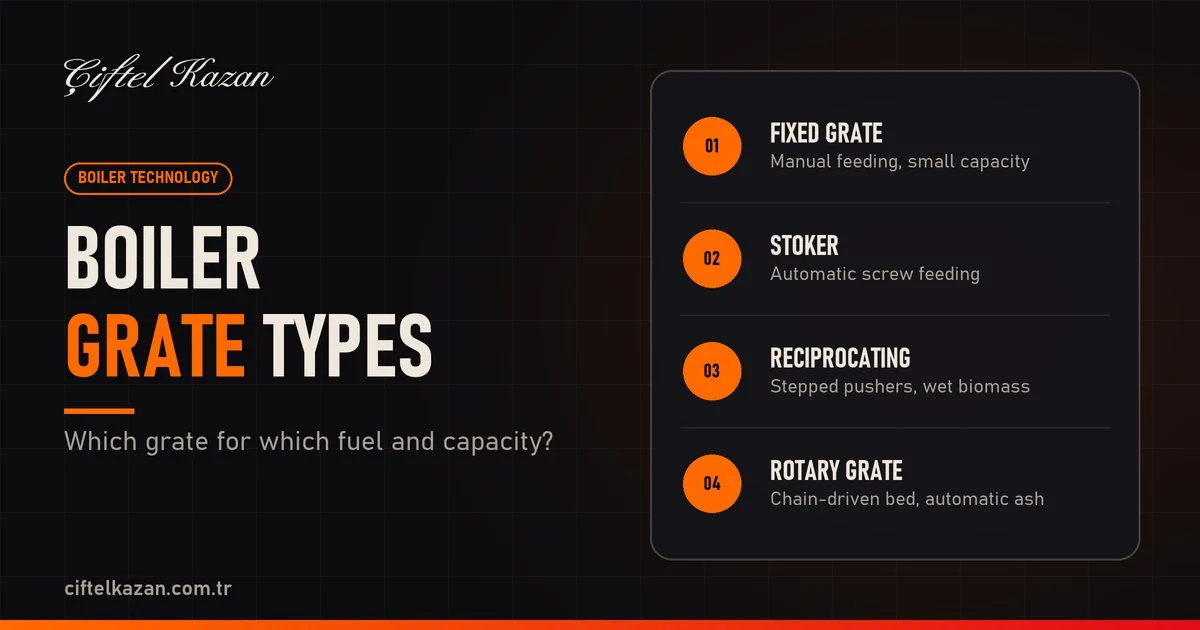
In solid fuel boiler systems, it is largely the grate that determines how the fuel burns. On the wrong grate, the same coal or biomass ends up half-burnt in the ash, forms clinker and keeps the operator busy all day; on the right grate, it burns steadily and automatically. That is why the choice among boiler grate types is an investment decision at least as important as the choice of fuel.
In this article, we compare the four basic boiler grate types, namely the fixed grate, stoker feeding, the reciprocating grate and the rotary grate, in terms of how they work, which fuels they suit, their level of automation and their maintenance needs. At the end, you will find a practical roadmap for choosing a grate according to your fuel and a list of common mistakes.
What are the boiler grate types?
Boiler grate types fall into four main groups according to how the solid fuel is conveyed through the furnace, how it is supplied with air and how the ash is removed: the manually fed fixed grate, the screw-fed stoker system, the reciprocating grate that advances the fuel with stepped elements, and the rotary grate that operates as a chain-driven moving bed. The choice depends on the fuel and the capacity.
Whatever the type, a grate has three basic functions: to carry the fuel throughout its combustion time, to distribute the combustion air evenly from beneath the fuel bed, and to remove the unburnt residue, i.e. the ash, from the furnace. What distinguishes the types is whether these three functions are performed manually or automatically, with which fuel and at what scale.
Fixed grate
The fixed grate is the simplest grate type: it does not move and is usually made of cast grate bars. Fuel is charged by hand, air comes up from below through the gaps between the bars, and the ash is raked and removed by hand at regular intervals. The investment is low; however, combustion fluctuates with every charge and the boiler is constantly dependent on the operator. For this reason, it remains limited to small-capacity heating boilers.
Stoker feeding
In a stoker-fired boiler, the fuel is conveyed steadily from a hopper directly to the combustion zone by a screw feeder. Because the feed rate is adjusted to the steam or temperature demand, combustion is far more stable than with manual feeding. A stoker works well with free-flowing fuels of a defined size, such as nut coal, pellets and dry shells, and is an economical solution for small to medium capacities.
Reciprocating grate
The reciprocating grate is a type of moving grate made up of an inclined, stepped surface. Some of the grate elements move back and forth, pushing the fuel gradually downward; along the way the fuel dries, gasifies, burns and finally drops off as ash. Boilers that operate with this grate are also known on the market as reciprocating-grate boilers.
Because the fuel is constantly agitated, the reciprocating grate is widely used for wet and heterogeneous biomass, such as wet wood chips, tree bark and forest residues. Since it has a large number of moving elements, it generally requires a hydraulic drive and regular maintenance.
Rotary grate (chain traveling grate)
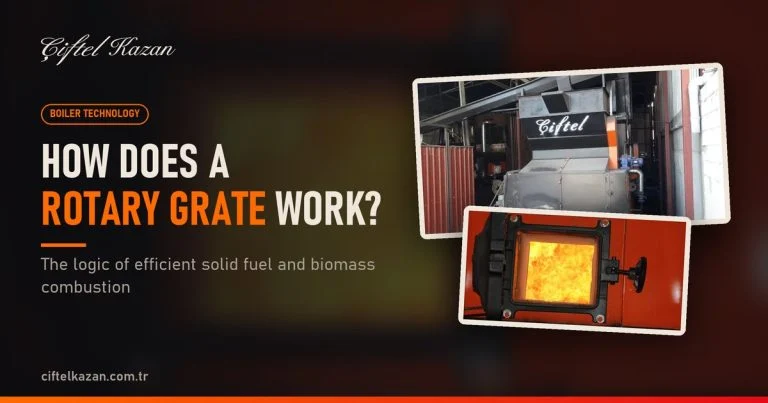
The rotary grate is a moving grate in which heat-resistant cast alloy plates advance continuously on chains, like a conveyor; in the industry it is also known as a chain grate. The fuel is spread in a uniform layer at the head of the grate, burns as the grate advances, and the ash is discharged by itself at the end of the grate. Combustion air is supplied from beneath the grate. It is suitable for medium- and high-capacity boilers in continuous operation.
Çiftel’s rotary-grate solid fuel combustion system is a patented design: a screw feeder and a guillotine rake spread the fuel uniformly on the grate, the bed thickness is adjusted automatically, and the fuel feed rate, grate speed and air volume are controlled together. We explain the operating principle step by step in our article how does a rotary grate work?
Comparison of fixed, stoker, reciprocating and rotary grates
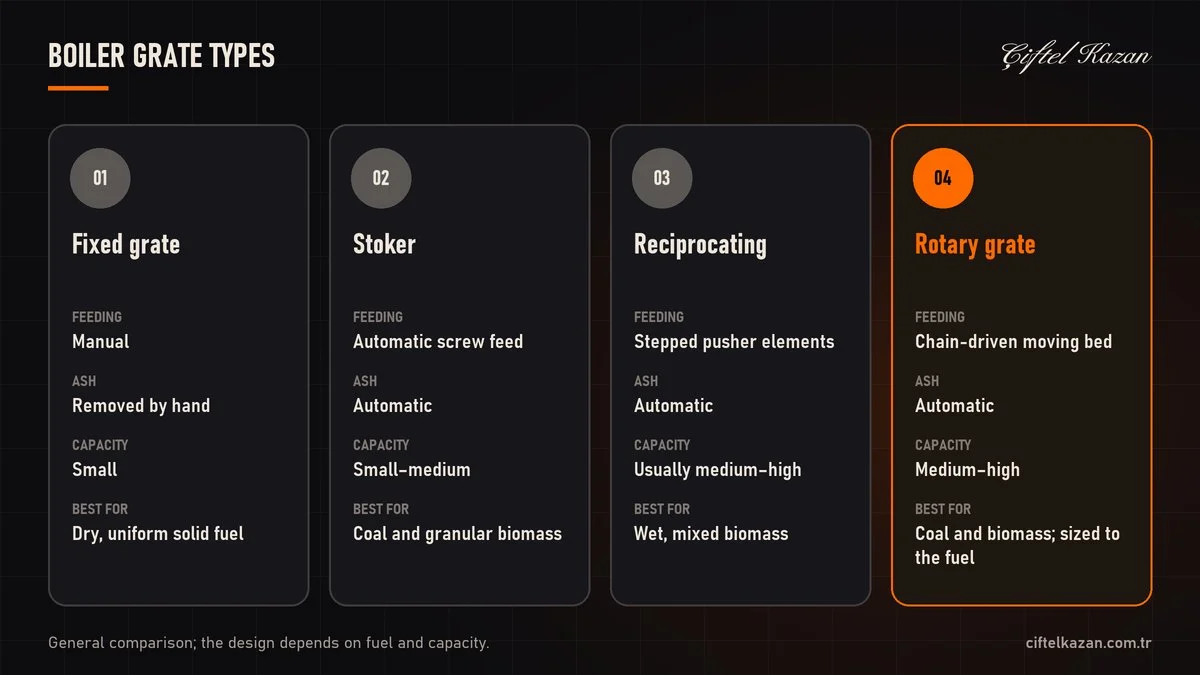
The table below sets the four boiler grate types side by side against the criteria that plant operators look at when making a decision. Capacity ranges are given qualitatively; the exact limits are determined by the fuel properties and the boiler design.
| Criterion | Fixed grate | Stoker | Reciprocating grate | Rotary grate |
|---|---|---|---|---|
| Fuel compatibility | Lump coal, wood; fuels that can be charged by hand | Free-flowing fuels of a defined size: nut coal, pellets, dry shells | Wet and heterogeneous biomass: wet wood chips, bark, forest residues | Suitably sized coal and biomass: hazelnut shells, pellets, olive pomace, sawdust |
| Capacity range | Small | Small–medium | Generally medium–high | Medium–high |
| Automation | Low; feeding and ash removal by hand | High; automatic screw feeding | High; hydraulic pusher elements | High; automatic spreading, bed thickness and grate speed control |
| Ash discharge | Manual | Automatic, depending on the system | Automatic, from the end of the grate | Continuous and automatic, from the end of the grate |
| Maintenance | Mechanically simple, heavy cleaning workload | Wear in the screw and combustion zone, checks for jamming | Maintenance of numerous moving elements and the hydraulic system | Scheduled maintenance of chain tension, grate plates and the drive unit |
| Suitable plant | Small, intermittent heat demand | Plants with small–medium steam and heat demand | Plants burning timber, forest products and wet biomass | Food, dairy, edible oil and textile plants with continuous steam demand |
In short: among boiler grate types, the fixed grate makes sense only for small and simple needs. The stoker stands out in small to medium plants that want automatic operation, the reciprocating grate in biomass with very high moisture and irregular particle size, and the rotary grate in plants with continuous, high steam demand.
How do you choose a grate according to the fuel?
The choice among boiler grate types starts with the identity of the fuel, before the boiler capacity. The decisive properties are the net calorific value, moisture, ash content, volatile matter and ash fusion temperature. These values directly affect the width and length of the grate, the bed thickness and the amount of combustion air.
- Imported and domestic coal: Screened coal of a suitable size burns efficiently on a rotary grate; at small capacities, nut-size coal can also be fired with a stoker. For domestic coals with a high ash content, the grate area and ash discharge are enlarged accordingly.
- Hazelnut shells, pellets, sunflower husks: These dry, homogeneous and free-flowing fuels suit both stoker and rotary-grate systems. As capacity grows, the rotary grate takes the lead.
- Olive pomace: Its ash content is relatively high and its moisture varies from batch to batch. The bed thickness and air distribution must be adjusted carefully to counter its tendency to form clinker; the continuous ash discharge of the rotary grate is an advantage with this fuel.
- Sawdust and wood chips: Dry sawdust can be burned on a rotary grate with a suitable design. For very wet, irregularly sized green wood chips and bark, however, the reciprocating grate is a common solution; in that case, drying the fuel or blending it with dry fuel should also be considered.
- Changing fuels: If you plan to switch between coal and biomass depending on fuel prices, choose a grate whose settings can be adjusted over a wide range.
At Çiftel, we ask for an analysis of the fuel to be used before we engineer a grate; we size the rotary grate according to the fuel’s calorific value, ash, moisture, volatile matter and fusion point. We have compiled the typical values of biomass fuels in a table in our biomass boiler guide.
Rotary grate or stoker-fired boiler?
At small and medium capacities, where the fuel size is uniform and consumption is relatively low, a stoker-fired boiler is more economical. At medium and high capacities, in plants that run continuously and whose fuel may change, the rotary grate is the better fit. The decision between these two boiler grate types is made by evaluating steam demand, daily operating hours and fuel properties together.
The stoker-fired water-tube boiler operates fully automatically with its fuel hopper, screw feeding and automatic ash discharge, and its installation and maintenance are simpler. The rotary grate, on the other hand, handles a wider range of fuels and a larger fuel throughput. For this reason, in plants with continuous steam demand we usually design the rotary grate together with our header-type water-tube boilers.
We have also compared the two systems, along with boiler types and fuel options, in our coal-fired boiler guide. If you have a natural gas or liquid fuel boiler, it is also possible to switch to solid fuel with a burner-type pre-furnace and a rotary grate, without replacing the boiler.
Mistakes made when choosing a boiler grate type
A large share of the problems we encounter in the field stem not from the boiler but from a grate that was selected or sized incorrectly. The most common mistakes when evaluating boiler grate types are:
- Looking only at the initial investment: A cheap grate soon becomes expensive through unburnt fuel left in the ash, high excess air and operator hours.
- Deciding without a fuel analysis: Saying “we will burn hazelnut shells” is not enough; the moisture and ash content of the same fuel can vary considerably depending on the supplier and the season.
- Sizing the grate on capacity alone: Low-calorific or wet fuel requires a higher fuel flow and a larger grate area for the same steam output.
- Ignoring the ash fusion point: With fuels whose ash softens at low temperatures, clinker clogs the air gaps of the grate; combustion deteriorates and the plates overheat.
- Leaving fuel storage and feeding for later: If bunker volume, screw capacity and bridging in fibrous fuels are not taken into account, even the best grate will be left without fuel.
- Locking yourself into today’s fuel: A grate that cannot switch to another fuel when fuel prices change weakens the plant’s bargaining power.
How does the boiler grate type affect efficiency?
The difference in efficiency between boiler grate types comes from the quality of combustion. When the fuel bed is of uniform thickness and the air is distributed correctly, the fuel burns completely, unburnt carbon in the ash decreases, and less heat escapes with the flue gas through excess air. On a manually fed fixed grate, by contrast, combustion is disrupted every time fuel is charged, and efficiency fluctuates.
On automatic grates, the fuel feed rate, bed thickness and air volume are adjusted in relation to one another, so the boiler stays stable even when the load changes. You can estimate the efficiency of your existing boiler with the boiler efficiency calculator and compare coal and biomass options by unit energy cost with the fuel cost comparison tool.
Let’s choose the right grate for your fuel together
There is no single right answer among boiler grate types that fits everyone; the right choice is determined by your fuel analysis, your steam demand and your operating pattern. At Çiftel Kazan, we have been manufacturing solid fuel boilers and patented rotary-grate combustion systems at our plant in Kemalpaşa, İzmir since 1986. To share your fuel details and steam requirements with us, contact us or call us on +90 232 479 11 21 / +90 544 479 11 21.
Frequently Asked Questions
Largely, yes. Rotary grate is the common industry name for the chain traveling grate, in which alloy plates advance continuously on chains. The fuel is spread at the head of the grate, burns as it advances, and the ash falls off by itself at the end of the grate. In Çiftel’s rotary grate, this is complemented by uniform spreading with a screw feeder, automatic bed thickness adjustment and air distribution from beneath the grate.
A reciprocating grate is used mainly for wet and heterogeneous biomass. Because the stepped elements agitate the fuel as they push it forward, irregular fuels such as wet wood chips, tree bark and forest residues can dry out and burn. For more homogeneous fuels such as hazelnut shells, pellets, olive pomace and dry sawdust, a rotary grate or, at small capacities, a stoker system is usually sufficient and a simpler solution.
A stoker-fired boiler is suitable for small and medium-capacity steam and heat demands. It operates fully automatically with screw feeding, a fuel hopper and automatic ash discharge, and its installation and maintenance are simple. As capacity grows and the plant runs continuously, rotary-grate systems, which cope better with higher fuel throughput and a wider variety of fuels, come to the fore.
To choose a grate, you need to know at least the net calorific value, moisture, ash content, volatile matter and ash fusion temperature. These values show how much air the fuel requires, how long it needs to stay on the grate and how high the risk of clinker is. The analysis should be carried out on a representative sample taken from the source you will actually be buying the fuel from; if possible, several samples from different seasons should be compared.
In most cases, yes. By adding a burner-type pre-furnace and a rotary-grate combustion system in front of a boiler that runs on natural gas or liquid fuel, the boiler can be converted to run on coal and biomass. This conversion is most commonly applied to Scotch-type boilers. Suitability is determined by examining the type, condition and capacity of the boiler during a site survey.
On a suitably sized rotary grate, often yes. However, since coal and biomass differ in calorific value, volatile matter content and ash behavior, the bed thickness, grate speed and air volume are readjusted for each fuel. If a change of fuel is planned, this should be stated at the grate design stage and the analyses of both fuels should be shared.
Other Posts
All
Need a boiler or pressure vessel?
Let’s plan the best solution for your project together, backed by 40 years of engineering experience.