
Steam Boiler Maintenance: Daily, Weekly, Monthly, and Annual Checklist
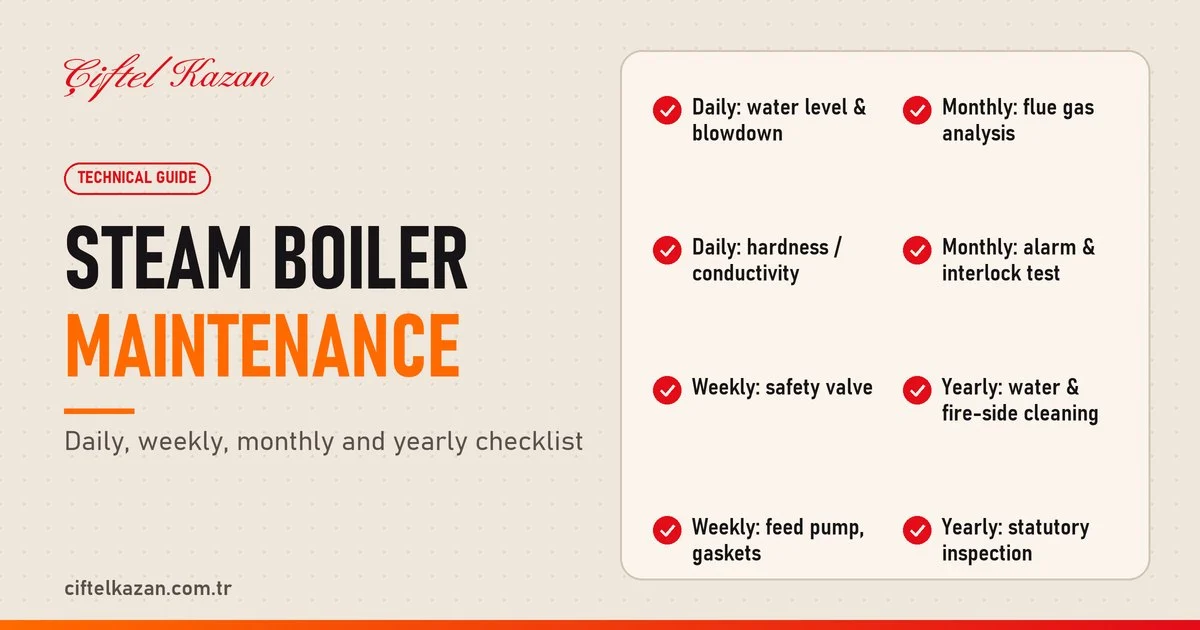
Steam boiler maintenance is fundamental to the safe, efficient, and long-lasting operation of the boiler. In equipment operating under pressure, minor negligence can turn into fuel loss, unplanned downtime, and safety risks over time. The good news is: with a regular checklist, most of these risks can be identified in advance and easily prevented.
In this guide, we explain the daily, weekly, monthly, and annual boiler maintenance checklist, periodic legal inspection, the role of water treatment, design differences that facilitate or hinder maintenance, and common failure symptoms.
What is Steam Boiler Maintenance and Why is it Important?
Steam boiler maintenance involves periodically checking water level, pressure, combustion, safety, and automation systems, cleaning the water and flue gas sides, and timely replacement of worn parts. The goal is to operate the boiler within safe limits and close to its design efficiency, and to catch potential failures before they grow and lead to unplanned downtime.
The benefit of steam boiler maintenance is not just safety. A thin layer of scale on the water side or soot accumulation on the flue gas side reduces heat transfer, increasing fuel consumption. Typically, a permanent increase of about 20 °C in flue gas temperature means approximately a 1% loss in efficiency.
Steam Boiler Maintenance Schedule: Daily, Weekly, Monthly, and Annual Checks
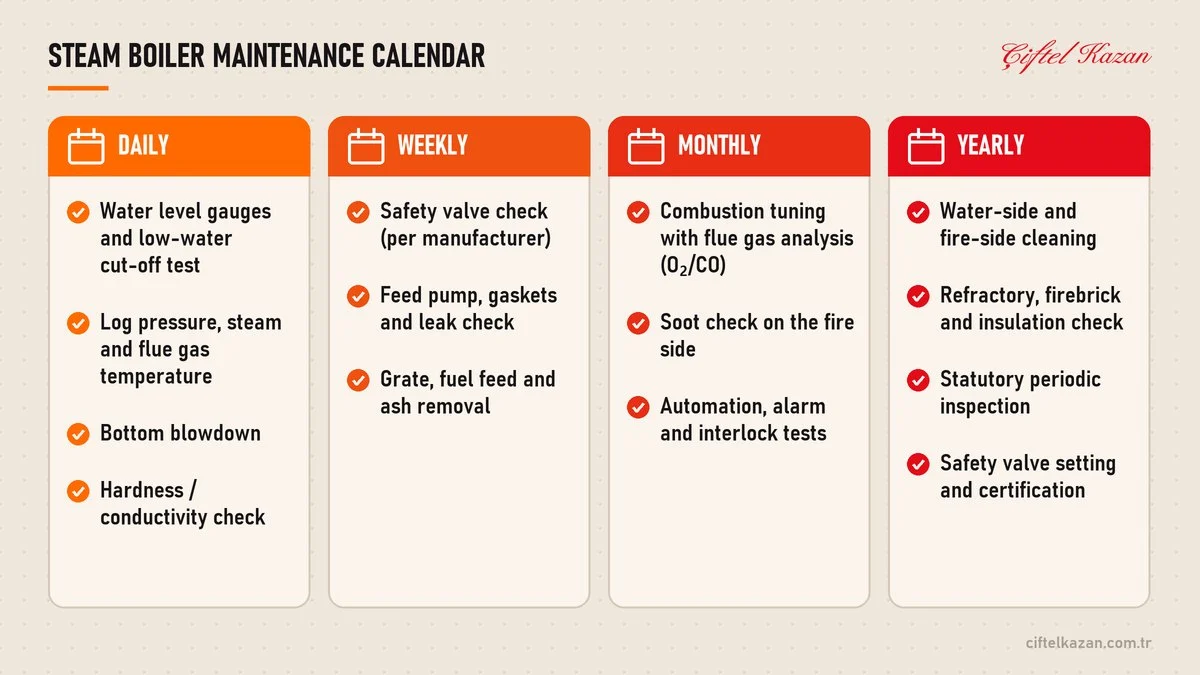
The boiler maintenance list below summarizes the common practice of steam boiler maintenance in industrial boilers. Your boiler’s user manual and manufacturer’s instructions always take precedence.
Daily Checks
Daily steam boiler maintenance is the operator’s job and takes a few minutes per shift.
- Test of water level indicators and low water safety: The level indicators are blown down to verify that the level is read correctly, and the low water safety is confirmed to stop firing.
- Recording of pressure, steam, and flue gas temperature: Values are recorded; sudden or permanent changes are early warnings.
- Bottom blowdown: Sludge and sediment accumulated at the bottom of the boiler are discharged at intervals determined by water analysis.
- Hardness/conductivity measurement: Hardness in feedwater and conductivity in boiler water are measured to confirm that water treatment is functioning.
Weekly Checks
- Safety valve check (according to manufacturer’s instructions): The valve’s free operation is checked using the method described by the manufacturer; leaking valves are noted.
- Feed pump, gasket, and seal check: Pump pressure and sound, gland leakage, flange, valve, and cover gaskets are inspected.
- Grate, fuel feed, and ash discharge check: For solid fuel boilers, the grate movement, fuel bed, screw conveyor, and ash system are checked. In rotary grate combustion systems, the regular operation of automatic ash discharge is part of this check.
Monthly Checks
- Combustion adjustment with flue gas analysis (O₂/CO): Excess air and unburnt gases are measured, and the burner or grate air setting is adjusted accordingly.
- Soot/carbon check on the flue gas side: Soot accumulation on accessible surfaces is checked, and cleaning is planned if necessary.
- Automation, alarm, and interlock tests: High pressure, flame, fan, and level alarms are tested for correct operation.
You can see your combustion loss using our flue gas loss calculator with the values you measure.
Annual Maintenance and Checks
- Water and flue gas side cleaning: The boiler is cooled down and drained; scale, sludge, soot, and ash are cleaned. This boiler cleaning also prepares the ground for internal inspection.
- Refractory/firebrick and insulation check: Cracks, spalling, and hot spots are identified and repaired.
- Periodic inspection by authorized personnel (hydrostatic test if necessary): Legal periodic inspection is carried out, and results are reported.
- Safety valve adjustment and certification: Valve opening pressure is verified, and adjustment and inspection are recorded.
| Period | Checks | Performed by |
|---|---|---|
| Daily | Test of water level indicators and low water safety; recording of pressure, steam, and flue gas temperature; bottom blowdown; hardness/conductivity measurement | Boiler operator |
| Weekly | Safety valve check (according to manufacturer’s instructions); feed pump, gasket, and seal check; grate, fuel feed, and ash discharge check | Operator and maintenance team |
| Monthly | Combustion adjustment with flue gas analysis (O₂/CO); soot/carbon check on the flue gas side; automation, alarm, and interlock tests | Maintenance team, qualified service for combustion adjustment |
| Annual | Water and flue gas side cleaning; refractory/firebrick and insulation check; periodic inspection by authorized personnel (hydrostatic test if necessary); safety valve adjustment and certification | Maintenance team and service; periodic inspection by authorized personnel |
How is Steam Boiler Periodic Inspection Performed?
Steam boilers are subject to periodic inspection under the Regulation on Health and Safety Conditions in the Use of Work Equipment. This inspection is carried out by authorized personnel defined in the regulation. The common practice for steam boilers is to perform the periodic inspection at least once a year.
Steam boiler periodic inspection typically includes the following steps:
- Review of boiler documents, previous inspection reports, and maintenance records,
- Internal and external visual inspection after the boiler is cooled down and opened,
- Functional tests of safety valves, low water cutoffs, pressure switches, and interlocks,
- Hydrostatic test if necessary,
- Reporting of results and rectification of deficiencies.
A hydrostatic test involves filling the boiler with water and raising it to a test pressure, above the operating pressure, as specified in the standard. The purpose is to demonstrate that there are no leaks or permanent deformations in the pressure parts. Since water is nearly incompressible, this test is much safer than a pressure test conducted with air.
Periodic inspection does not replace daily steam boiler maintenance. The inspection documents the boiler’s condition on that day; it is the daily and weekly discipline in between that keeps the boiler safe throughout the year.
Water Treatment and Blowdown: The Unseen Half of Maintenance
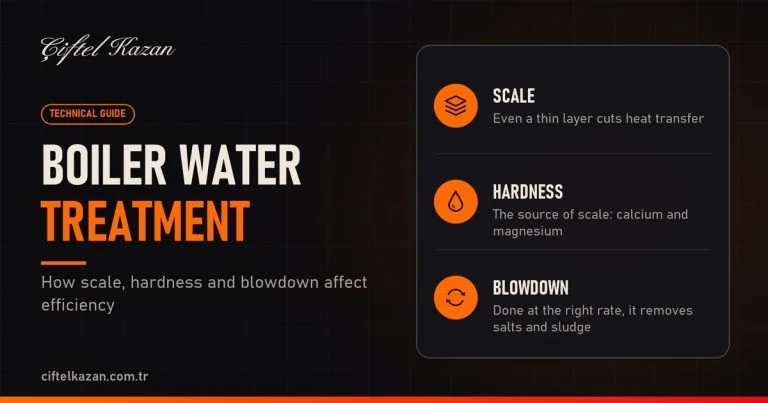
A significant portion of boiler failures starts on the water side. Hardness causes scale, dissolved oxygen leads to corrosion, and high conductivity causes foaming and carryover of water with steam. Therefore, water treatment is an integral part of steam boiler maintenance.
- Softening: Feedwater hardness is removed; hardness measurement is a daily routine.
- Deaerator: Oxygen and carbon dioxide in the feedwater are removed to prevent corrosion.
- Blowdown: Surface blowdown removes dissolved solids, while bottom blowdown removes sludge. Insufficient blowdown leads to scale and foaming, while excessive blowdown leads to heat and water loss.
You can find the correct blowdown rate with our blowdown calculator and examine the balance of hardness, conductivity, and blowdown in detail in our boiler water treatment guide.
How Boiler Design Affects Maintenance
Ease of maintenance is often overlooked when selecting a boiler. However, the boiler’s design directly determines the duration and cost of steam boiler maintenance over the years. The most obvious example is tube replacement in water-tube boilers.
- Header type boiler: Tubes are expanded into header boxes at both ends. Thanks to the maintenance covers on the header surface, a faulty tube can be individually removed and replaced, returning the boiler to its original heating surface.
- D-type boiler: Curved tubes are connected between the steam and water drums, and the furnace walls consist of membrane tubes. Therefore, it is not possible to replace a faulty tube in place; the tube is blanked off and removed from service, and each blanking reduces the heating surface slightly.
This is not a defect but a design choice: the D-type boiler is a strong option for high-capacity applications using natural gas and liquid fuels. However, this difference must be known when planning maintenance. We have compared the two designs in detail in our article D-type boiler or header type boiler.
Çiftel’s patented header-type water-tube steam boiler was designed with this structure to facilitate tube replacement. The firebrick and stone wool insulation are the main items we review during the annual refractory inspection.
Qualified Operator and Maintenance Logbook
Even the best maintenance plan is only as good as the person implementing it. A qualified operator who monitors the boiler daily, reads the values, and notices small deviations catches most failures before they become serious. We explained the value a qualified operator brings to operations in our article qualified boiler operator.
The maintenance logbook is the memory of steam boiler maintenance. It can be printed or digital; what matters is that it is kept regularly. The logbook should include at least the following:
- Pressure, steam, and flue gas temperature values on a shift basis,
- Blowdown performed, and hardness and conductivity measurements,
- Results of low water safety, safety valve, and alarm tests,
- Failures, interventions performed, and parts replaced,
- Periodic inspection and hydrostatic test reports.
A regularly maintained logbook shows trends: if the flue gas temperature is slowly rising over weeks, cleaning is approaching. The logbook is also the most reliable source of information during periodic inspections and service consultations.
Common Boiler Failures and Their Symptoms
Regular steam boiler maintenance allows most of the following problems to be caught at the first symptom. When you notice a symptom, record it and investigate the cause; early intervention prevents major repairs.
| Failure | Symptom | Possible Cause | What to Do |
|---|---|---|---|
| Scaling on the water side | Increase in flue gas temperature and fuel consumption | High hardness, insufficient treatment | Check water analysis, plan cleaning |
| Soot/carbon on the flue gas side | Increase in flue gas temperature, dark smoke | Incorrect combustion adjustment, insufficient air | Perform flue gas analysis, adjust combustion |
| Corrosion and tube leakage | Increase in feedwater consumption, steam or wetness in the furnace | Dissolved oxygen, improper water chemistry | Check deaerator and water chemistry, report leakage to service |
| Foaming and water carryover | Fluctuation in the sight glass, wet steam | High conductivity, insufficient blowdown | Review surface blowdown and conductivity limits |
| Low water cutoff failure | Low water alarm, discrepancy between indicator and cutoff | Dirty water level chamber, feed pump issue | Test the low water cutoff, blowdown the chamber |
| Safety valve leakage | Continuous steam leakage from the valve | Dirt on the seat surface, adjustment deviation | Have the valve adjusted and maintained by authorized service |
| Unbalanced combustion on the grate | Unburnt fuel in ash, slag, high CO | Bed thickness or air distribution error, fuel moisture | Check grate speed, bed thickness, and air settings |
| Refractory damage | Hot spot or discoloration on the outer casing | Cracked or spalled firebricks | Repair the refractory when the boiler is stopped |
An important safety rule: If the water level is not visible in the sight glass, do not add water to the boiler. First, stop firing and let the boiler cool down in a controlled manner; adding cold water to overheated metal can cause serious damage.
Conclusion: Regular Maintenance, Safe and Efficient Boiler
Steam boiler maintenance is not a complex task, but a discipline. Daily checks lasting a few minutes, weekly and monthly tests, and periodic inspections by authorized personnel at least once a year will keep your boiler safe, efficient, and long-lasting.
As Çiftel Kazan, we have been manufacturing boilers and providing service throughout Turkey since 1986. Contact us to review your steam boiler maintenance plan, evaluate failure symptoms, or request service, or reach us at +90 232 479 11 21 / +90 544 479 11 21.
Frequently Asked Questions
Steam boiler maintenance is not a one-time job but a layered schedule. Water level, pressure recording, bottom blowdown, and water measurements are done daily; safety valve, feed pump, and grate checks are done weekly; combustion adjustment and alarm tests are done monthly. Comprehensive cleaning and periodic inspection by authorized personnel are performed at least once a year.
The periodic inspection is carried out by authorized personnel under the Regulation on Health and Safety Conditions in the Use of Work Equipment. Routine maintenance performed by the company’s own team, no matter how regular, does not replace this inspection. The common practice for steam boilers is to perform the periodic inspection at least once a year and document the results with a report.
A hydrostatic test is a check for leaks or deformations in pressure parts by filling the boiler with water and raising it to a test pressure above the operating pressure. It is applied at the end of manufacturing, after major repairs, and when deemed necessary during periodic inspection. It is a safe testing method because water is nearly incompressible.
Bottom blowdown removes sludge and sediment that accumulate in the lower part of the boiler over time through short and controlled openings. If not performed, sediment can build up on the heating surfaces, reducing heat transfer and potentially causing localized overheating. The frequency and duration of blowdown should be determined by the boiler water analysis; in most facilities, bottom blowdown is part of the daily routine.
If boiler cleaning is neglected, scale will build up on the water side and soot on the flue gas side, both reducing heat transfer. As a result, flue gas temperature will rise, fuel consumption will increase, and the risk of overheating in the tubes will arise. Annual water and flue gas side cleaning is the most effective way to bring the boiler closer to its design efficiency.
The safety valve is a critical safety component that should generally be checked for operation weekly according to the manufacturer’s instructions, and its opening pressure verified and certified annually. A valve that continuously leaks steam or is stuck should be shown to authorized service without delay, and unauthorized personnel should not tamper with its adjustment.
Other Posts
All

Need a boiler or pressure vessel?
Let’s plan the best solution for your project together, backed by 40 years of engineering experience.