
A Qualified Boiler Operator Saves More Than Their Salary: Calculating the Annual Savings
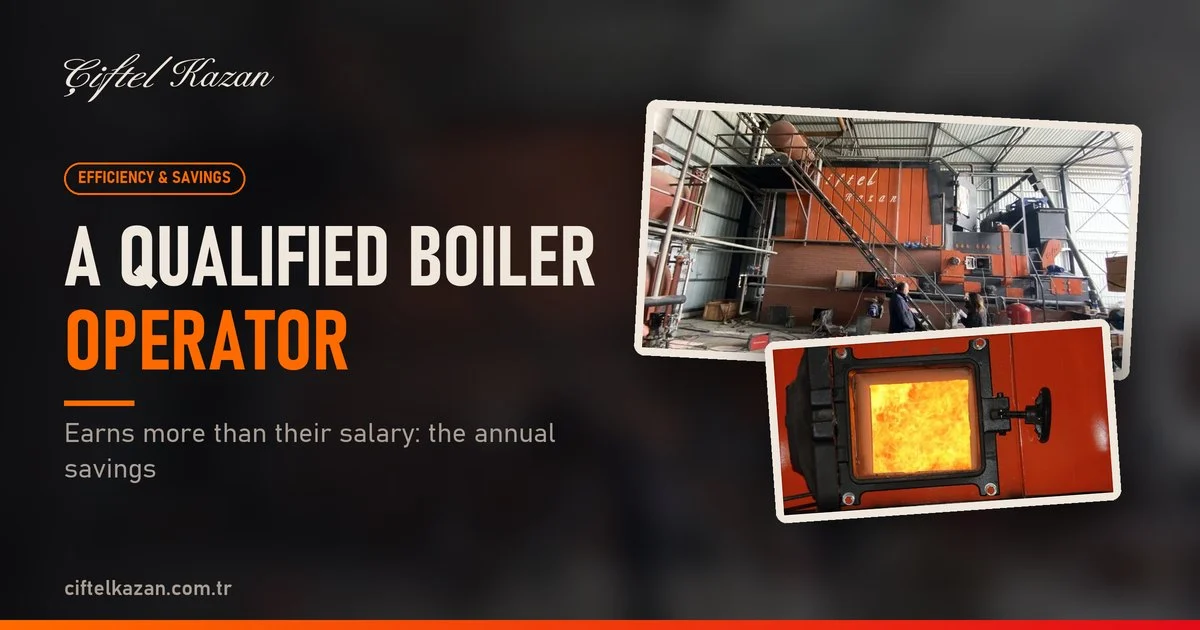
In most businesses, the boiler room is viewed as an expense item; the boiler operator’s salary is also considered part of this expense. From this perspective, the selection of an operator is often based on the lowest cost. However, the largest variable expense in the boiler room is not the salary, but fuel. And the person in charge of the boiler largely determines how efficiently the fuel is used.
In this article, we demonstrate the benefits a qualified operator brings to a business using a concrete calculation for a factory that uses 40–50 metric tons of steam per day.
How Does an Operator Affect Boiler Efficiency?
The same boiler can yield very different results under the supervision of two different operators. The main tasks managed daily by a qualified operator include:
- Combustion air adjustment: Excess air carries heat away through the flue; insufficient air prevents complete fuel combustion. The correct adjustment is made by monitoring the oxygen level in the flue gas.
- Grate speed and fuel bed: In rotary grate boilers, the grate speed and the thickness of the fuel bed determine whether the fuel burns completely. Unburned fuel in the ash is a direct financial loss.
- Load control: Operate the boiler in a balanced manner according to steam demand, avoid frequent start-stop cycles, and maintain stable pressure.
- Cleaning of heating surfaces: Soot and ash buildup on tube surfaces reduce heat transfer; an increase in flue gas temperature is the first sign of this.
- Blowdown discipline: Excessive blowdown results in the loss of hot water and energy; insufficient blowdown, on the other hand, leads to the buildup of salt and sludge in the boiler.
- Water treatment control: If hardness, pH, and conductivity measurements are not performed regularly, scaling reduces efficiency and causes pipe damage.
- Recording and monitoring: Regular recording of fuel consumption, steam production, and flue gas values enables early detection of problems.
Each of these factors alone can result in a difference in efficiency of a few percentage points. Taken together, the difference between a well-maintained boiler and a poorly maintained one can reach 10–15% in fuel consumption in the field.
Assumptions of the Calculation
| Assumption | Value |
|---|---|
| Daily steam consumption | 40 and 50 metric tons |
| Net heat required for 1 metric ton of steam | Approximately 600,000 kcal (approximately 10 bar saturated steam, feedwater 70–80 °C) |
| Fuel | Soma coal, lower heating value approximately 5,000 kcal/kg (4,500–5,500 depending on quality) |
| Coal price | 10,000–12,000 TL/metric ton (assumed average price; varies depending on quality, transportation, and season) |
| Boiler efficiency (under suboptimal operating conditions) | 75% — approximately 6.25 kg of steam per 1 kg of coal |
| Fuel consumption under proper operation | 10–15% less coal for the same amount of steam |
| Annual operation | 300 days |
Step 1: The Plant’s Annual Coal Consumption
| 40 metric tons of steam per day | 50 metric tons of steam per day | |
|---|---|---|
| Daily coal | 6.4 metric tons | 8.0 metric tons |
| Annual coal (300 days) | 1,920 metric tons | 2,400 metric tons |
| Annual coal cost (10,000 TL/metric ton) | 19.2 million TL | 24.0 million TL |
| Annual coal cost (12,000 TL/metric ton) | 23.0 million TL | 28.8 million TL |
Step 2: Annual Savings with a Qualified Operator
| Scenario | 40 metric tons of steam per day | 50 metric tons of steam per day |
|---|---|---|
| 10% less coal, 10,000 TL/metric ton | 192 metric tons → 1,920,000 TL | 240 metric tons → 2,400,000 TL |
| 10% less coal, 12,000 TL/metric ton | 192 metric tons → 2,304,000 TL | 240 metric tons → 2,880,000 TL |
| 15% less coal, 10,000 TL/metric ton | 288 metric tons → 2,880,000 TL | 360 metric tons → 3,600,000 TL |
| 15% less coal, 12,000 TL/metric ton | 288 metric tons → 3,456,000 TL | 360 metric tons → 4,320,000 TL |
In other words, proper operation at a plant of this scale translates to annual savings of approximately 1.9 to 4.3 million TL on fuel alone. These savings are equivalent to increasing boiler efficiency from 75% to approximately 83–88%.
Step 3: Comparison with Wage Differences
When the boiler room operates 24/7, three shifts are required, meaning at least three operators are needed. Let’s assume the monthly salary of a standard operator is 35,000 TL, and that of a qualified and experienced operator is 65,000–70,000 TL:
- Monthly difference per operator: 30,000–35,000 TL
- Annual additional salary for three operators: 3 × (30,000–35,000) × 12 = 1,080,000–1,260,000 TL
| Scenario | Annual savings | Annual additional salary | Net profit |
|---|---|---|---|
| Most conservative (40 metric tons/day, 10%, 10,000 TL/metric ton, 35,000 TL difference) | 1,920,000 TL | 1,260,000 TL | +660,000 TL |
| Medium (45 metric tons/day, 12.5%, 11,000 TL/metric ton, 32,500 TL difference) | 2,970,000 TL | 1,170,000 TL | +1,800,000 TL |
| Best (50 metric tons/day, 15%, 12,000 TL/metric ton, 30,000 TL difference) | 4,320,000 TL | 1,080,000 TL | +3,240,000 TL |
In other words, every additional 1 TL paid to a qualified operator yields a return of approximately 1.5 to 4 TL in fuel savings in these scenarios. When salaries are calculated including employer costs (Social Security contributions, taxes), the difference increases slightly; even in the most conservative scenario, where the profit margin narrows, the fuel savings still offset the additional salary costs.
Beyond the Money: Safety and Continuity
This calculation covers only fuel. The benefits of a qualified operator are not limited to this:
- Safety: Water levels, safety valves, pressure, and alarm systems are the most critical aspects of pressurized equipment. An operator who monitors these with expertise is the first line of defense for the safety of people and property.
- Preventing Breakdowns: An operator who detects abnormal noises, temperatures, and readings early can intervene before major breakdowns and unplanned outages occur.
- Boiler lifespan: Proper water treatment and regular maintenance extend the life of boiler tubes and refractory lining.
- Production continuity: A steam outage means the entire plant comes to a halt. The cost of a single day’s downtime can, in many facilities, exceed an operator’s annual salary premium on its own.
How Are Qualified Operators Trained?
A qualified operator is someone who has received vocational training, holds the relevant certification, and has a thorough understanding of the boiler they operate. Operational training provided by the boiler manufacturer, regular refresher courses, and a work routine supported by measurement devices (flue gas analyzer, water test kits) make a good operator even more valuable. It is also important for the boiler room to have basic measurement and recording capabilities so that the operator can base their decisions on measurements.
You can find information on how combustion is managed in rotary grate boilers in our article on rotary grates, and details on other factors affecting efficiency—such as water treatment and economizers—in our respective articles.
Let’s Evaluate Your Boiler Room Together
As Çiftel Kazan, we have been manufacturing steam, thermal oil, and hot water boilers at our facility in Kemalpaşa, Izmir, since 1986. Contact us or reach out via the +90 232 479 11 21 / +90 544 479 11 21 numbers to assess the current status of your boiler room together and discuss what can be done to improve efficiency and reduce costs.
Frequently Asked Questions
Yes. The combined effect of daily decisions—such as combustion air, grate speed, cleanliness of heating surfaces, and blowdown—can result in a fuel difference of approximately 10–15% on-site. The exact value depends on the boiler, the fuel, and the initial operating quality.
Simply plug your daily steam consumption (or fuel consumption), your fuel’s calorific value, and its unit price into the steps above. If your fuel consumption is known, you can directly calculate the savings range by determining 10% and 15% of your annual fuel cost.
The most practical method is to compare the fuel consumed with the steam produced over a specific period. When values obtained from flue gas analysis (oxygen, carbon monoxide, temperature) are added, efficiency losses become clearer.
Automation simplifies the operator’s job and reduces errors, but it does not replace the operator. A knowledgeable operator who monitors the accuracy of settings, interprets measurements, and intervenes in unusual situations is always necessary.
Other Posts
All
Need a boiler or pressure vessel?
Let’s plan the best solution for your project together, backed by 40 years of engineering experience.