
Boiler Water Treatment: The Effect of Scale, Hardness, and Blowdown on Efficiency
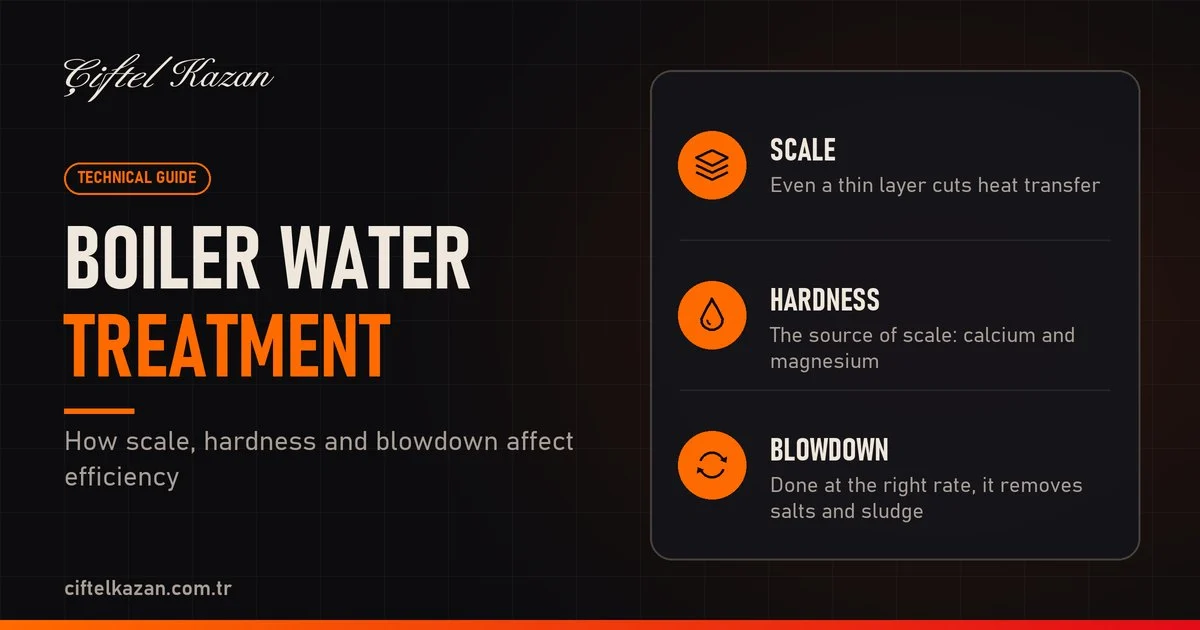
In a steam boiler, water is not merely a “substance that turns into steam”; it is one of the most important factors determining the boiler’s lifespan and efficiency. The dissolved minerals and gases in the water cause serious problems over time by accumulating inside the boiler or corroding the metal. Water treatment encompasses all processes designed to prevent these problems before they enter the boiler.
Substances That Cause Problems in Boiler Water
- Hardness (calcium and magnesium): As water heats up, the solubility of these minerals decreases, and they precipitate as a hard layer on heating surfaces, forming scale.
- Silica: It can form hard, difficult-to-remove deposits, especially at high pressures.
- Total Dissolved Solids (TDS): As water evaporates, TDS becomes concentrated in the boiler; when it exceeds a certain level, it causes foaming and carryover of water with the steam.
- Dissolved gases: Oxygen and carbon dioxide cause corrosion. We discussed this topic in detail in our article on deaerators.
Why Is Scale So Expensive?
Scale is a material that conducts heat very poorly. When it coats heating surfaces, it results in two consequences:
- Fuel loss: Heat transfer to the water becomes more difficult; more fuel is required to produce the same amount of steam, and flue gas temperature rises. According to sources, even a scale layer just a few millimeters thick can significantly increase fuel consumption.
- Overheating and tube damage: The scale layer prevents the metal from being cooled by the water. The metal temperature rises, which can lead to swelling, deformation, and, in the worst case, rupture of the tubes.
In water-tube boilers, water quality is even more critical due to the thin tubes and high heat load. While a header-type design facilitates tube replacement, the primary goal is to prevent any damage to the tubes.
Steps in Water Treatment
1. Pre-filtration
Suspended solids, sand, and sediment are trapped by filters. This protects downstream equipment.
2. Softening
Ion-exchange resin softeners remove hardness by replacing calcium and magnesium with sodium. The resin is regenerated with brine at regular intervals. An empty salt tank or a failure in the regeneration process are among the most common causes of hard water entering the boiler.
3. Reverse Osmosis (when necessary)
If the raw water has high levels of dissolved solids and silica, a reverse osmosis system removes most of these substances. This also reduces the need for blowdown.
4. Deaeration
The deaerator removes oxygen and carbon dioxide from the feedwater.
5. Chemical Treatment
Chemicals are dosed to bind residual oxygen, maintain the boiler water’s pH within the appropriate range, and prevent residual hardness from adhering to surfaces. Chemical selection should be based on the boiler type, pressure, and water analysis.
Which Parameters Should Be Monitored?
Limit values for feedwater and boiler water are specified in the relevant standards (TS EN 12953-10 for fire-tube boilers, TS EN 12952-12 for water-tube boilers) and in the boiler manufacturer’s instructions, depending on the boiler type and operating pressure. The key measurements to monitor on a daily basis are as follows:
| Measurement | Why is it important? |
|---|---|
| Feedwater hardness | Indicates that the water softener is functioning; hardness should be close to zero. |
| Boiler water conductivity (TDS) | Indicates whether the blowdown volume is correct. |
| Boiler water pH | Indicates the balance between corrosion and scaling. |
| Chemical residues | Confirms that the dosage is adequate. |
Blowdown: Not Too Little, Not Too Much
As water evaporates, the dissolved substances remain in the boiler and their concentration increases. Blowdown is the process of removing a portion of this concentrated water from the boiler to allow cleaner feedwater to enter.
- Surface (continuous) blowdown: Performed continuously or automatically from an area near the water surface to control the concentration of dissolved solids.
- Bottom blowdown: Performed at specific intervals for short periods to remove sludge and sediment accumulated in the lower section of the boiler.
Insufficient blowdown leads to foaming, water carryover with the steam, and deposits. Excessive blowdown, on the other hand, wastes heated, treated water and chemicals—which directly results in fuel and water loss. Conductivity-based automatic blowdown systems maintain this balance by adjusting the blowdown according to need. The heat from the blowdown water can be recovered using a flash tank and heat exchangers.
Daily Checklist
- Hardness test at the water softener outlet
- Monitoring the salt tank level and regeneration
- Boiler water conductivity and pH measurement
- Chemical dosing pump and tank level
- Performing bottom blowdown according to instructions
- Monitoring deaerator pressure and temperature
Performing these checks regularly is among the most important duties of a qualified boiler operator. In this article, we calculated the benefits the operator brings to the plant.
Let’s Evaluate Your Boiler Room Together
As Çiftel Kazan, we have been manufacturing steam, thermal oil, and hot water boilers at our facility in Kemalpaşa, Izmir, since 1986. Contact us or reach out via the +90 232 479 11 21 / +90 544 479 11 21 numbers to assess the current status of your boiler room together and discuss what can be done to improve efficiency and reduce costs.
Frequently Asked Questions
A gradual increase in flue gas temperature and fuel consumption under the same load are important indicators. A definitive diagnosis is made by inspecting the heating surfaces during periodic internal inspections.
Generally, yes. A water softener removes hardness, but functions such as oxygen scavenging, pH control, and preventing residual hardness from adhering to surfaces are provided by chemical treatment.
Surface blowdown is adjusted continuously or automatically based on the conductivity of the boiler water. The frequency and duration of bottom blowdown, however, are determined according to the boiler manufacturer’s instructions and water analysis.
It has a positive effect. Condensate is very clean water; as the return rate increases, the need for makeup water—and consequently, softening, chemical treatment, and blowdown—decreases. See our article on condensate for details.
Other Posts
All

Need a boiler or pressure vessel?
Let’s plan the best solution for your project together, backed by 40 years of engineering experience.