
Steam Generator or Steam Boiler? Differences and the Right Choice
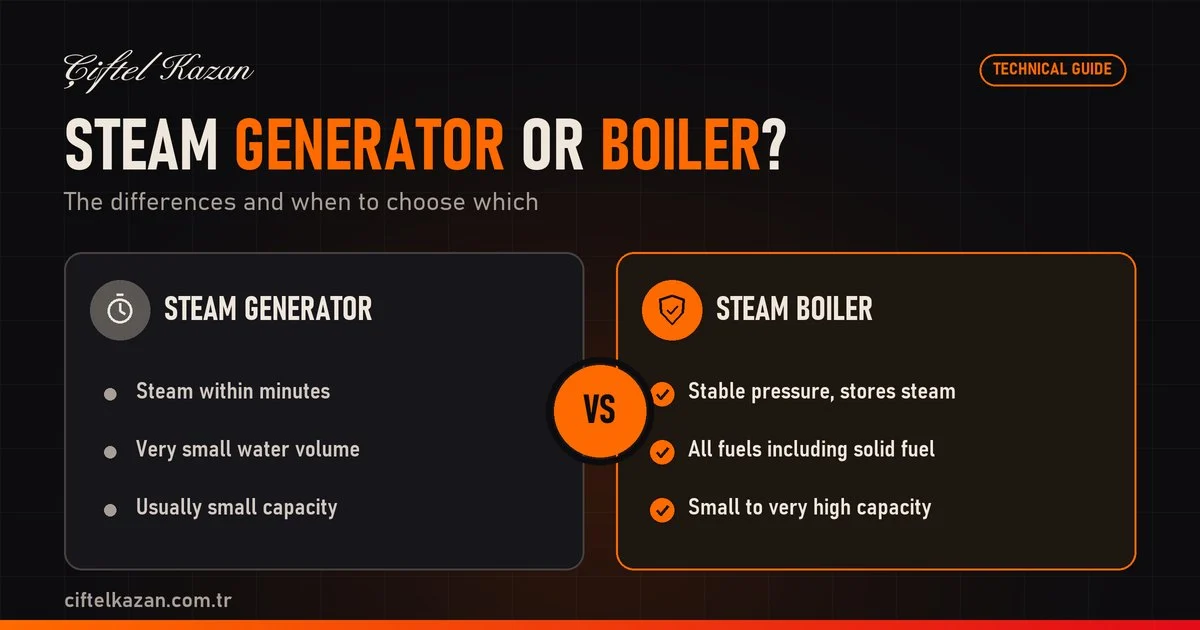
For a plant that needs steam fast, a steam generator looks attractive: a compact unit that delivers steam within minutes. The steam boiler, with its large water volume and stable pressure, is the classic industrial solution. Both produce steam, but they do not do the same job in the same way. The wrong choice can lead either to constantly fluctuating pressure or to an unnecessary investment.
In this article, we compare the steam generator and the steam boiler in terms of design, capacity, water quality, fuel and efficiency. We also look at when each one makes sense and address some common misconceptions.
What Is a Steam Generator?
A steam generator is a compact steam production unit in which water is pumped through a tube, usually of once-through or coil design, and heated, turning into steam along the length of the tube. Because it holds very little water, it delivers steam from a cold start within minutes. It is generally built in small capacities and runs on gas, liquid fuel or electricity.
The operating principle is simple. The feed pump forces water into the coil inlet, and a burner or electric heater heats the tube. As the water advances, it heats up and evaporates. Because some water can be carried over with the steam at the outlet, applications that require dry steam may need a steam separator.
An electric steam generator produces heat with resistance elements or electrodes. Since there is no combustion and no flue gas, there are no emissions at the point of use. However, its operating cost depends largely on the unit price of electricity.
What Is a Steam Boiler and How Does It Work?
A steam boiler is a system that heats a large volume of water inside a shell, steam drum or tube bundles and accumulates pressurized steam in the steam space above it. In Scotch (fire-tube) types, the combustion gases pass through the tubes; in water-tube types, the water flows inside the tubes. In both designs, the hot water and steam in the boiler act as an energy store.
This store prevents the pressure from collapsing when steam demand suddenly rises. Until the burner or grate catches up with the load, the boiler keeps supplying steam from its stored energy. Steam boilers can be built from small to very high capacities and can run on all fuels, including solid fuels. We cover the differences between the two main boiler families in detail in our article Scotch boiler or water-tube boiler?
Steam Generator vs Steam Boiler: Comparison Table
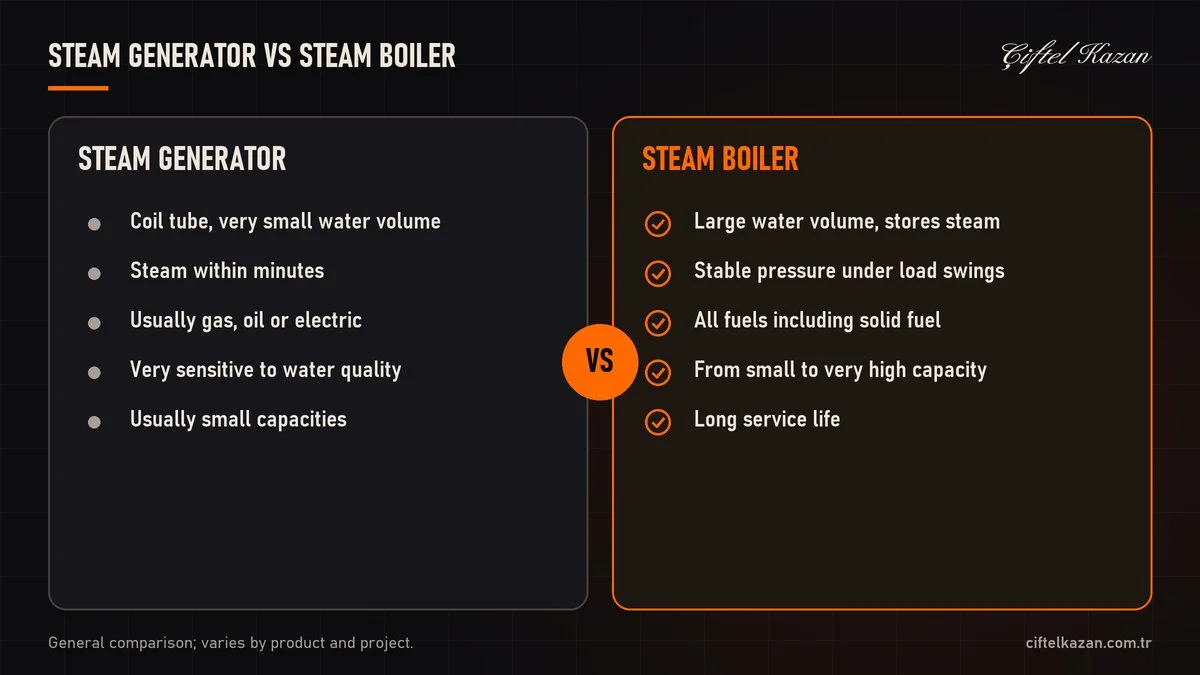
The fundamental difference between the two technologies is water volume; most of the other differences stem from it. A small amount of water heats up quickly but stores little energy. A large amount of water heats up more slowly but easily absorbs load fluctuations.
| Criterion | Steam generator | Steam boiler |
|---|---|---|
| Design | Once-through or coiled tube, pump-fed | Large water volume in a shell, steam drum or tube bundle |
| Water volume | Very small | Large |
| Cold start to steam | Usually minutes | Longer; relatively fast in water-tube types |
| Steam storage | Low | High |
| Pressure under sudden load | May fluctuate | Stable |
| Capacity | Usually small | From small to very high capacities |
| Fuel | Gas, liquid fuel, electricity | Solid, liquid, gas; rotary grate for solid fuel |
| Sensitivity to water quality | Very high | High, but manageable thanks to the large water volume and blowdown |
| Steam dryness | May require a separator | Dry steam thanks to the steam space and separators |
| Footprint | Compact | Larger |
| Service life | Highly dependent on water quality and maintenance | Long; thick-walled construction, replaceable parts |
Strengths and Weaknesses of the Steam Generator
Strengths
- Fast steam production: It usually delivers steam from a cold start within minutes. Standby losses are low in plants that operate intermittently.
- Compact design: It takes up little space, and installation is relatively simple.
- Modular expansion: In industrial steam generator applications, several units can be brought online side by side as demand grows.
- Low water volume: The energy that could be released in the event of a failure is lower than in boilers with a large shell.
Limitations
- Highly sensitive to water quality: Because evaporation is completed inside a narrow tube, hardness and dissolved salts deposit directly on the tube wall. Strict softening, oxygen removal and, where necessary, reverse osmosis are usually required.
- Little steam storage: Pressure fluctuates under sudden, large steam draws. The burner has to follow the load very quickly.
- Steam dryness: Water can be carried over with the steam when the load fluctuates; a separator and good condensate drainage may be needed.
- Fuel limitation: A small water volume is not compatible with a solid-fuel bed, which has high thermal inertia. That is why gas, liquid fuel or electricity is generally used.
- Capacity limit: It is generally economical at small capacities; large demands require many units.
Strengths and Weaknesses of the Steam Boiler
- Stable pressure: The large volume of water and steam absorbs sudden draws. When large consumers such as autoclaves, cooking kettles or dryers come online, the pressure does not easily collapse.
- Fuel flexibility: In addition to natural gas and liquid fuels, economical solid fuels such as coal and biomass can be fired automatically on a rotary grate.
- Wide capacity range: It scales from small businesses to plants consuming tens of t/h of steam. The header-type boilers delivered by Çiftel include systems operating at a capacity of 25 t/h and a pressure of 25 bar.
- Long service life: Thanks to its thick-walled shell and replaceable parts, it serves for many years. In the header-type water-tube design, the tubes can be removed and replaced one by one.
The weakness of the steam boiler is that it takes up more space and takes longer than a generator to go from a cold start to steam. However, water-tube boilers come online faster than Scotch types. Thanks to firebrick and rock wool insulation, Çiftel’s header-type boilers can retain their heat for 24 hours. This shortens the reheating time in plants with stop-start operation.
Which One Should You Choose, and When?
The short answer is this: if your steam demand is small and intermittent and your space is limited, a steam generator may make sense. If you have a continuous, medium- or high-capacity steam demand with fluctuating loads, or if you want to lower your fuel costs with solid fuel, a steam boiler is usually the right choice.
A steam generator usually makes sense when
- Steam demand is small and limited to certain hours of the day
- Fast start-up is critical and keeping a boiler hot is not economical
- Space for a boiler room is very limited
- Combustion is not wanted at the point of use and the cost of electricity is acceptable (electric steam generator)
A steam boiler usually makes sense when
- Steam demand is continuous or spread over most of the day
- Large consumers suddenly come online and go offline
- The aim is to lower fuel costs with solid fuels such as coal or biomass
- High pressure or high capacity is required
- The goal is a long-lasting investment that can be maintained on site
Which steam boiler for which need?
There is no single right answer on the steam boiler side either. Common matches among the boilers Çiftel manufactures are as follows:
- Small–medium capacity, solid fuel: The Package-Type Water-Tube Rotary-Grate Steam Boiler comes close to the space advantage of a generator with its compact design and offers solid-fuel flexibility.
- Small–medium capacity, natural gas: The Natural Gas-Fired Scotch-Type Boiler provides stable pressure with its large water volume.
- Medium–high capacity, continuous operation, solid fuel: The Header-Type Water-Tube Rotary-Grate Steam Boiler offers high efficiency and easy tube-by-tube maintenance.
- High capacity, natural gas or liquid fuel: A D-type water-tube boiler is suitable. For details, see our D-type boiler guide.
The right capacity is determined by the total steam demand of the consumers and their simultaneity. For an initial estimate, you can start with the steam boiler capacity calculator and read the details in our article on selecting steam boiler capacity.
Common Misconceptions About Steam Generators
“A steam generator is always more efficient”
Efficiency depends on the load profile. The generator’s small water volume does genuinely reduce heat-up and standby losses in intermittent use. Under continuous, high load, however, a well-tuned steam boiler with an economizer can achieve similar or even higher efficiency. Small units that frequently cycle on and off also incur pre-purge and reheating losses at every shutdown.
Moreover, the unit cost of steam is often determined more by the type of fuel than by efficiency. You can compare the cost of steam with different fuels using the steam cost calculator.
“A generator is small, so safety is not an issue”
A small water volume reduces the risk but does not eliminate it. Every device that produces steam under pressure is pressure equipment. Safety valves, pressure limiters, regular maintenance and periodic inspection by authorized persons are required. In once-through designs, the tube can overheat rapidly if the feedwater supply is interrupted; that is why protections for the water supply are particularly important.
“A generator does not need water treatment”
The opposite is true. A small water volume and narrow tubes lower the tolerance to scale and corrosion. Whichever system you choose, boiler water treatment is a fundamental issue for the plant.
Conclusion: Define Your Steam Profile First
A steam generator is a fast, compact solution for small, intermittent needs. For continuous, fluctuating or high-capacity steam demand, and when solid-fuel flexibility is desired, a steam boiler is usually the more stable and economical investment. The key to the right decision is evaluating capacity, load profile, fuel and water quality together.
At Çiftel Kazan, we have been designing and manufacturing steam boilers in Kemalpaşa, İzmir since 1986. With the experience gained in more than 1,250 projects, we can review your plant’s steam profile together. Contact us or reach us at +90 232 479 11 21 / +90 544 479 11 21.
Frequently Asked Questions
The fundamental difference is water volume: a steam generator holds very little water, while a steam boiler contains a large volume of water and steam. As a result, a generator delivers steam within minutes, but its pressure may fluctuate when the load changes. A boiler heats up more slowly but provides stable pressure, reaches high capacities and can run on all fuels, including solid fuels.
Not always; efficiency depends on the load profile. In intermittent, short-duration use, the generator’s low standby losses are an advantage. Under continuous, high load, however, a well-tuned steam boiler with heat recovery can achieve similar or even higher efficiency. In addition, the effect of fuel type on the unit cost of steam is often greater than the difference in efficiency.
An electric steam generator makes sense in small-capacity applications where combustion is not wanted at the point of use. It requires no chimney or fuel installation and produces no emissions at the point of use. However, its operating cost depends directly on the unit price of electricity. As steam demand grows, its cost disadvantage compared with a fuel-fired steam boiler usually becomes more pronounced.
Generally not; steam generators mostly run on gas, liquid fuel or electricity. A very small water volume is not compatible with the thermal inertia of a solid-fuel bed, which takes time to ignite and to die down. For plants that want to use coal or biomass, rotary-grate water-tube steam boilers are a more suitable solution.
Yes; in fact, it is even more critical than for a steam boiler. Because evaporation is completed inside a narrow tube, hardness and dissolved salts deposit directly on the tube wall. This buildup quickly reduces heat transfer and can lead to tube damage. Softening, oxygen removal and, where necessary, reverse osmosis are usually required, together with regular water analysis.
As steam demand becomes continuous and capacity grows, a steam boiler is usually the better choice. Rather than a fixed capacity threshold, the load profile should be considered. Sudden large draws, consumption spread over most of the day, the need for high pressure and the desire to use solid fuel all favor the boiler. Capacity is calculated from the total demand of the consumers and their simultaneity.
Other Posts
All
Need a boiler or pressure vessel?
Let’s plan the best solution for your project together, backed by 40 years of engineering experience.