
Scotch Boiler or Water-Tube Boiler? Choosing the Right Steam Boiler for Your Business
Investing in a steam boiler is a decision that will determine whether a business pays more or saves money for years to come. Choosing the wrong type of boiler means unnecessary fuel consumption, low efficiency, and production downtime. The right choice, however, means trouble-free and cost-effective steam for many years.
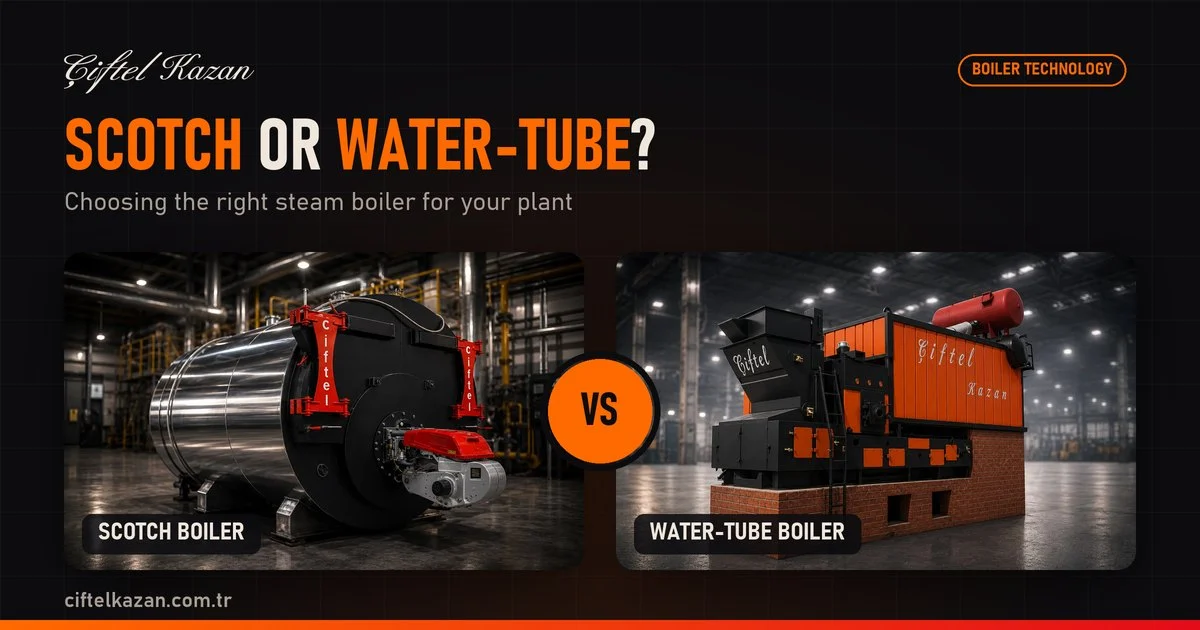
There are two main types of boilers most commonly used in industrial steam production: Scotch (fire-tube) boilers and water-tube boilers. Both produce steam, but their operating principles, operating pressures, and costs differ significantly. In this article, we compare the two boiler types, explain the advantages of water-tube boilers, and discuss which one is suitable for which business.
What Is a Scotch (Fire-Tube) Boiler?
In a Scotch boiler, hot combustion gases flow through the tubes, while water is contained within the large outer shell (cylinder) surrounding the tubes. The high-temperature gases produced by combustion transfer their heat to the water as they pass through the tube bundles immersed in the water, thereby generating steam.
Modern Scotch boilers are typically designed with three passes: After exiting the combustion chamber, the gases pass through two additional tube bundles, transferring most of their heat to the water. This reduces flue gas temperature and increases efficiency.
Key features:
- Thanks to its large water volume, pressure fluctuations are minimal during sudden steam demands; the boiler essentially acts as a small steam reservoir.
- It has a compact, one-piece design; installation and operation are relatively simple.
- The initial investment cost is lower.
Limitations:
- Since the large water volume must be heated, startup (transition from cold to steam) takes longer.
- There is a practical upper limit on pressure and capacity. Generally, it is an economical solution up to 25 bar and approximately 20–25 metric tons per hour of steam.
- Because it contains a large volume of pressurized water, the energy that could be released in the event of a failure is much higher than in water-tube boilers.
What Is a Water-Tube Boiler?
In a water-tube boiler, the principle is reversed: Water flows through the tubes, while hot combustion gases circulate around the outside of the tubes. The water circulating through the small-diameter tubes heats up rapidly and vaporizes.
This design is ideal for applications requiring high pressure and high capacity. Small-diameter tubes withstand high internal pressure much more safely than larger vessels.
Advantages of Water-Tube Boilers
1. Safety
In a water-tube boiler, water is contained in small volumes within the tubes. Since there is no large volume of pressurized water in the boiler, the energy that could be released in the event of a failure is low. For this reason, water-tube boilers are considered safe in terms of explosion risk.
2. High Pressure and Capacity
The water-tube design can achieve pressures and capacities far exceeding the economic limits of fire-tube boilers. In industrial applications, pressures of 25 bar and above, along with high ton-per-hour capacities, are safely met by water-tube boilers.
3. Rapid Start-up and Load Tracking
Thanks to its low water volume, the boiler reaches steam production more quickly and responds more rapidly to changes in steam demand.
4. Wide Furnace Suitable for Solid Fuel
Water-tube boilers are designed with rotary grate combustion systems, enabling them to efficiently burn solid fuels such as coal and biomass. We explained how the rotary grate works in this article.
5. Flexibility
In facilities with variable and high steam demand, water-tube boilers offer more flexible operation.
Points to Consider: The initial investment cost for water-tube boilers is higher, and water quality is critical. Since scale or corrosion in the fine tubes can lead to serious malfunctions, a good water treatment system is essential. For more details, please refer to our article on water treatment.
Comparison Table
| Criterion | Scotch (fire-tube) | Water-tube |
|---|---|---|
| Operating Principle | Gas in the tubes, water outside | Water in the tubes, gas outside |
| Pressure | Medium (up to ≈25 bar) | High |
| Capacity | Low–medium (≈20–25 t/h) | Medium–Very High |
| Commissioning | Slower | Fast |
| Response to load changes | Large water volume smooths out fluctuations | Provides a quick response |
| Safety (pressurized water volume) | High water volume | Low water volume |
| Initial investment | More economical | Higher |
| Water quality sensitivity | Medium | High |
Which One Is Right for Which Business?
The right choice depends more on your plant’s steam profile than on strict rules.
A Scotch boiler might be right for you if:
- Your steam demand is moderate and relatively stable,
- medium pressure (generally below 25 bar) is sufficient,
- Lower initial investment and simple operation are your priorities,
- You plan to use a gaseous fuel such as natural gas.
A water-tube boiler may be the right choice for you if:
- High pressure and/or high capacity are required,
- Your steam demand fluctuates rapidly and frequently, and quick startup is important,
- You plan to use solid fuels such as coal or biomass,
- You are prepared to install and operate a good water treatment system.
The final decision depends on the steam flow rate, operating pressure, fuel type, load profile, and budget. We’ve explained how to calculate capacity in this guide.
Çiftel Header-Type Water-Tube Steam Boiler: Without the Disadvantages of a Water-Tube System
A well-known challenge with water-tube boilers is that the thin tubes are sensitive to water quality, and replacing tubes in conventional systems can be difficult and costly. Çiftel Kazan’s patented header-type water-tube steam boiler was developed to address this drawback through its design.
In a header-type system, the tubes are connected to headers (collectors) at both ends. The most significant advantage of this design is that the tubes can be removed and replaced individually. When a tube wears out over time, only the affected tube is replaced instead of overhauling the entire boiler:
- The framework remains intact, and the boiler is renewed through tube replacement.
- You retain the high efficiency and capacity advantages of a water-tube boiler, and tube damage is no longer a costly problem.
- The boiler’s lifespan is extended, and maintenance costs are reduced.
You can find all the advantages of the header-type design in this article, and its technical specifications on our product page.
Let’s Determine the Right Boiler Together
As Çiftel Kazan, we manufacture both Scotch (fire-tube) and water-tube steam boilers at our own facility. Therefore, rather than steering you toward a specific type, we recommend the most appropriate and cost-effective solution based on your facility’s actual needs. With our 40 years of experience and our fuel-saving engineering approach, we accurately calculate your capacity, design the most efficient boiler, and install a system that will operate trouble-free for many years.
Frequently Asked Questions
In a Scotch boiler, combustion gases pass through the tubes, and the water is contained in a large shell. In a water-tube boiler, however, the water circulates inside the tubes, while the gases heat the tubes from the outside.
Since the volume of pressurized water is small in water-tube boilers, the energy released in the event of a malfunction is low; therefore, they are considered safer in terms of explosion risk. Proper operation and periodic inspections are the foundation of safety for both types.
Generally, it is an economical solution up to 25 bar and approximately 20–25 metric tons per hour. For higher pressures and capacities, water-tube boilers are the preferred choice.
Water-tube boilers designed with a rotary grate combustion system offer a robust solution for solid fuel and biomass. To operate an existing Scotch boiler with solid fuel, pre-furnace solutions can be considered; details are available in our article on pre-furnaces.
Contact us to find out which boiler type is right for your business, or reach us at +90 232 479 11 21 / +90 544 479 11 21.
Other Posts
All
Need a boiler or pressure vessel?
Let’s plan the best solution for your project together, backed by 40 years of engineering experience.