
Converting Your Existing Boiler to Solid Fuel: Reduce Fuel Costs with a Pre-Furnace
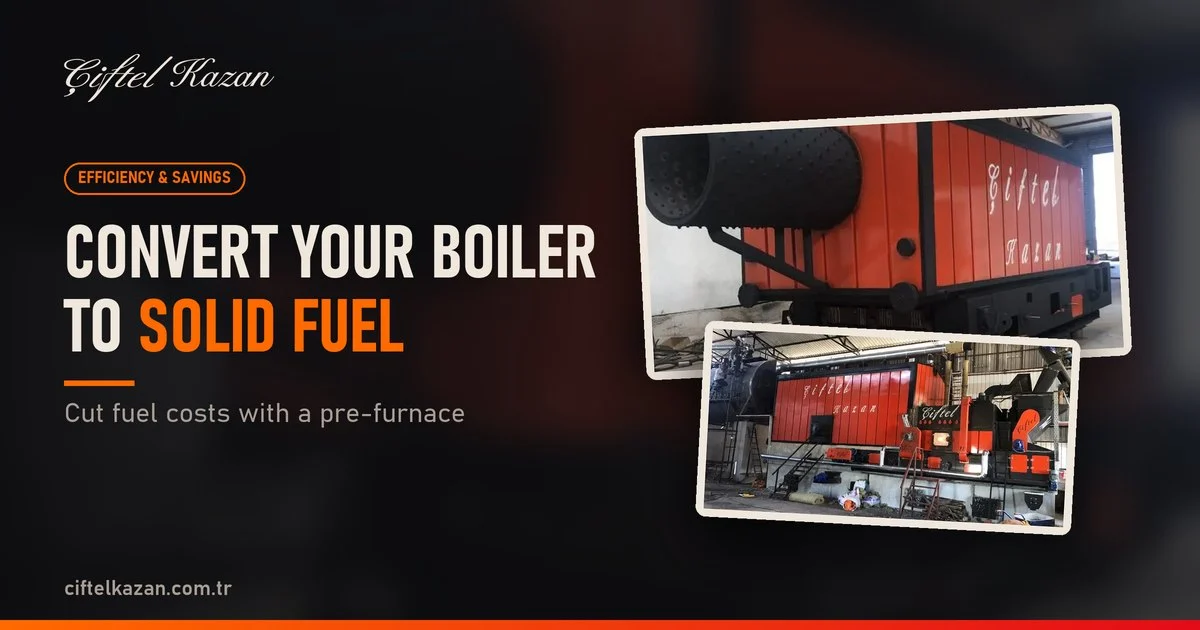
Many businesses have a fire-tube (Scotch-style) boiler that runs on natural gas or liquid fuel. When fuel costs rise, the first question that comes to mind is: Is it possible to switch to a more economical fuel without replacing the boiler? For boilers in suitable condition, the solution is a preheater installed in front of the boiler.
What Is a Pre-Furnace?
A pre-furnace is a combustion system installed in front of an existing boiler that performs combustion in a separate chamber. Solid fuel is burned in a controlled manner on a rotary grate in the pre-furnace; the resulting hot combustion gases are directed into the boiler, transferring their heat to the water inside. The boiler continues to function as a heat exchanger.
This allows the facility to produce steam using solid fuel or biomass without modifying its boiler, steam distribution system, or consumers.
Field Examples
- Kaya Kardeşler purchased a rotary-grate pre-furnace from Çiftel Kazan to improve the efficiency of their existing Scotch boiler.
- BG Konserve opted for a rotary-grate pre-furnace combustion system while continuing to use its existing systems.
Advantages of a Pre-Furnace
- Lower investment: The existing boiler is utilized instead of purchasing a new one.
- Fuel cost advantage: Solid fuels and biomass can often be more economical per unit of heat.
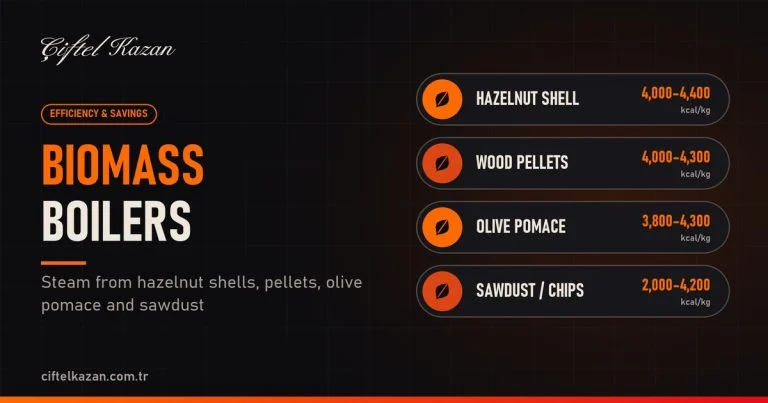
- Fuel flexibility: The rotary grate pre-furnace can burn coal and biomass fuels such as olive pomace, olive pits, and hazelnut shells.
- Automatic and controlled combustion: The rotary grate continuously feeds the fuel, burns it in a controlled manner, and automatically discharges the ash. We explained how it works in this article.
Factors to Consider Before Making a Decision
The Boiler’s Condition
The boiler’s age, periodic inspection results, wall thicknesses, and overall condition should be examined. Instead of adding a pre-furnace to a boiler that has reached the end of its service life, it may be more appropriate to install a new boiler.
Capacity Compatibility
The capacity at which the boiler will operate efficiently with a solid-fuel pre-furnace must be determined through engineering calculations. The capacity achieved with gas fuel may not always be the same as that achieved with solid fuel.
Space and Logistics
Sufficient space is required in the boiler room for the pre-furnace, fuel storage, fuel feeding system, and ash removal. The transportation and storage of fuel at the facility must also be planned.
Flue Gas and Permits
In solid-fuel systems, cyclone or filter systems may be required to capture particulates in the flue gas. Additionally, local environmental regulations and the necessary permits must be checked when switching to solid fuel.
Operation
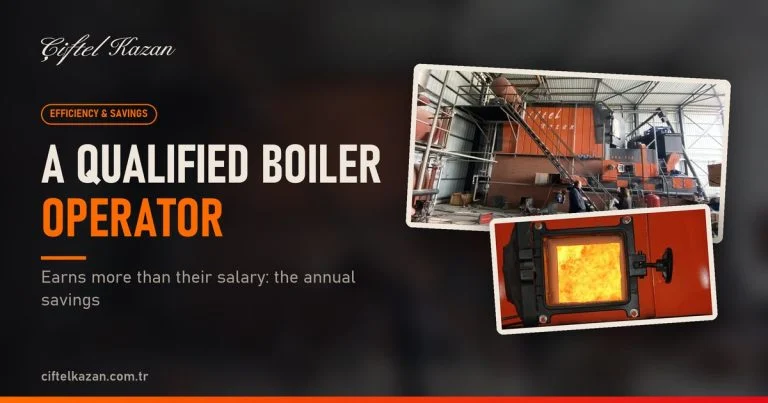
A solid fuel system requires an operator knowledgeable in areas such as fuel feeding, grate and air adjustment, and ash removal. In this article, we calculated the impact of proper operation on fuel savings.
How Does a Pre-Furnace Project Proceed?
- Site survey: The boiler type, age, condition, and boiler room layout are examined; current steam demand and fuel consumption are assessed.
- Fuel selection: A locally available and economical solid fuel or biomass is identified; the fuel’s properties guide the design.
- Design: The pre-furnace’s dimensions, grate area, air system, fuel feeding, and ash removal solution are designed to be compatible with the existing boiler.
- Manufacturing and installation: The pre-furnace is manufactured and connected to the boiler on-site; the fuel feeding, fan, and ash removal systems are installed.
- Commissioning: The system is commissioned according to steam requirements by adjusting the grate speed, air distribution, and fuel feeding settings.
A Simple Way to Compare Fuel Costs
The comparison should be based not on the unit fuel price, but on the cost of the useful heat entering the boiler. For 1,000,000 kcal of useful heat:
| Soma coal (example) | Natural Gas | |
|---|---|---|
| Heat value (approx.) | 5,000 kcal/kg | 8,250 kcal/m³ |
| Boiler efficiency (assumed) | 75% | 90% |
| Required fuel | ≈ 267 kg | ≈ 135 m³ |
| Unit price | 11,000 TL/metric ton (average estimate) | Price per m³ on your bill |
| Cost of 1,000,000 kcal of useful heat | ≈ 2,930 TL | ≈ 135 × price per m³ |
In this example, if the unit price of natural gas is above approximately 21.8 TL/m³, solid fuel becomes more cost-effective in terms of fuel costs. However, when making a decision, expenses other than fuel must also be taken into account: operator costs, ash removal, maintenance, flue gas treatment, and fuel storage. Performing the same calculation using your own prices will yield the most accurate result.
Let’s Evaluate Your Boiler Room Together
As Çiftel Kazan, we have been manufacturing steam, thermal oil, and hot water boilers at our facility in Kemalpaşa, Izmir, since 1986. Contact us or reach out via the +90 232 479 11 21 / +90 544 479 11 21 numbers to assess the current condition of your boiler room together and discuss what can be done to improve efficiency and reduce costs.
Frequently Asked Questions
No. Suitability is determined by examining the boiler type, condition, capacity, and the layout of the boiler room. In unsuitable cases, a new boiler may be a better investment.
In a rotary-grate pre-furnace, coal and biomass fuels such as olive pomace, olive pits, hazelnut shells, wood chips, and pellets can be used. The system is adjusted according to the fuel to be used.
The duration varies depending on the condition of the boiler, the necessary connections, and the scope of the fuel feeding and ash handling systems. A site survey conducted prior to the project will determine the exact duration.
In a properly designed and operated system, solid fuel is burned efficiently. Efficiency depends on the quality of the fuel, the air adjustment, and the cleanliness of the boiler’s heating surfaces.
For our pre-furnace solutions, please visit our pages on Burner-Type Pre-Furnace and Rotary Grate Solid Fuel Combustion Systems.
Other Posts
All
Need a boiler or pressure vessel?
Let’s plan the best solution for your project together, backed by 40 years of engineering experience.