
Fuel Savings with an Economizer: Recovering Heat Lost Through the Chimney
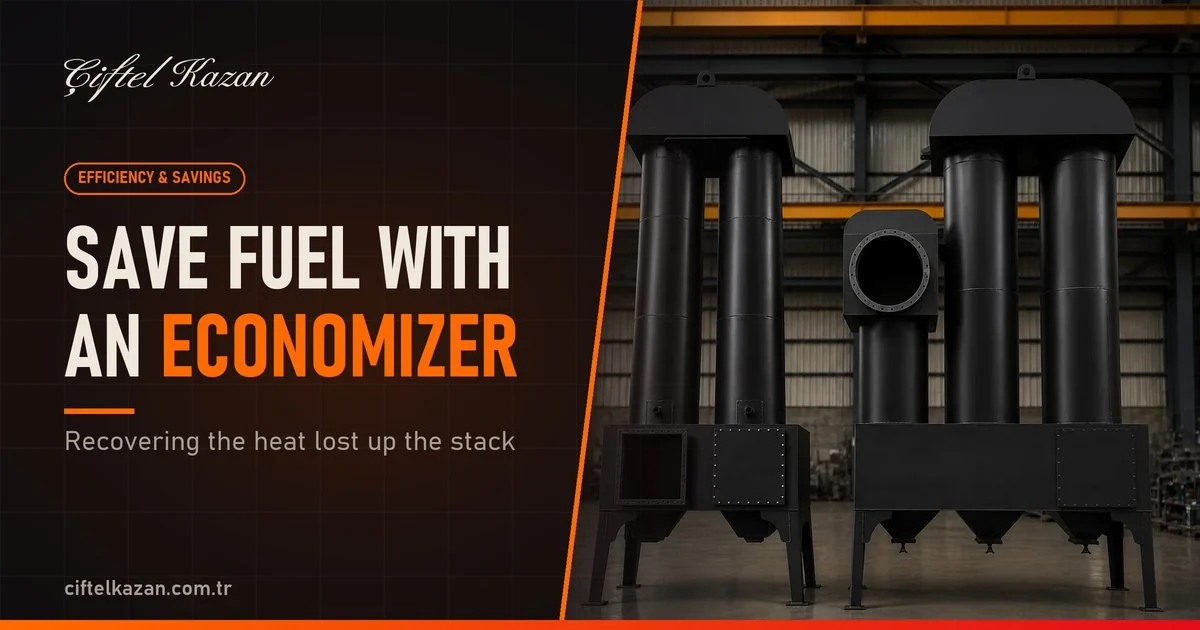
In a steam boiler, not all of the heat generated by the fuel is converted into steam. The greatest loss is the heat that escapes into the atmosphere with the hot combustion gases exiting the flue. The hotter the flue gas, the more energy is wasted. An economizer is a heat exchanger that recovers a portion of this heat and returns it to the boiler.
What Is an Economizer, and How Does It Work?
An economizer is a tube-type heat exchanger installed at the boiler’s flue gas outlet. As the feedwater sent to the boiler passes through the economizer’s tubes, the hot flue gases flowing from outside heat the water. As a result:
- The flue gases are released into the atmosphere at a lower temperature,
- Hotter feedwater enters the boiler,
- Less fuel is consumed to produce the same amount of steam.
How Much Does It Save?
According to a commonly used approach in practice, a drop of approximately 20 °C in flue gas temperature results in an approximate 1% increase in boiler efficiency. In boilers operating without an economizer, flue gas temperature can be quite high; an economizer can reduce this temperature by several dozen degrees, contributing a few percentage points to efficiency. The exact value depends on the fuel, the boiler’s current flue gas temperature, and the economizer’s design.
Sample Calculation
Consider a facility that uses 45 metric tons of steam per day and burns Soma coal (approximately 5,000 kcal/kg, current boiler efficiency 75%, operating 300 days per year). This facility consumes approximately 2,160 metric tons of coal per year. If the economizer reduces flue gas temperature by approximately 80 °C, thereby reducing fuel consumption by 4%:
- Annual coal savings: 2,160 × 0.04 ≈ 86 metric tons
- At an average price of 11,000 TL/metric ton: approximately 950,000 TL/year
This savings is realized every year. The payback period for the investment can be roughly calculated by dividing the cost of the economizer by this annual savings.
For Which Boilers Is It Suitable?
- Continuously operating boilers: Savings are directly proportional to operating hours; the payback period is shorter for boilers operating for long hours.
- Boilers with high flue gas temperatures: The amount of heat that can be recovered increases with flue gas temperature.
- Solid-fuel and natural gas boilers: It can be used with both; the design is tailored to the fuel type.
Points to Consider
Acid Dew Point
In fuels containing sulfur (such as coal), if the flue gas is cooled below a certain temperature, the sulfur compounds within it condense to form acid, which corrodes the economizer and flue surfaces. For this reason, a minimum limit for flue gas outlet temperature is maintained based on the fuel’s sulfur content; in coal-fired systems, this limit is typically kept around 130–150 °C.
Feedwater Temperature
If the water entering the economizer is too cold, it can cause localized condensation on the tube surfaces. Hot feedwater from the deaerator reduces this risk. We explained the role of the deaerator in this article.
Soot and Ash Deposition
Especially in solid-fuel systems, economizer tubes become coated with soot and ash over time, which reduces heat transfer. Regular cleaning and monitoring of flue gas temperature help maintain efficiency. A gradual increase in flue gas temperature over time is a sign that it is time for cleaning.
Protection of the Water Side
Economizer tubes are just as sensitive to water quality as boiler water. Dissolved oxygen can cause corrosion in the economizer; proper water treatment is essential here as well.
What to Consider When Selecting an Economizer?
- Heat transfer surface and tube type: Designs include smooth-tube or finned-tube configurations. Finned tubes provide a more compact surface area; however, they may be more prone to fouling when burning solid fuels with high ash content. The selection should be based on the type of fuel.
- Pressure loss on the flue gas side: The economizer adds resistance to the flue gas flow. It must be verified whether the existing fan can handle this additional resistance.
- Water-side pressure: The economizer operates at boiler pressure downstream of the feed pump; the design pressure must be appropriate for this.
- Access for cleaning: Inspection hatches and cleaning access are important for maintaining efficiency, especially in solid-fuel systems.
- Measurement points: The ability to measure flue gas and water temperatures at the economizer inlet and outlet facilitates monitoring of performance and fouling.
A Real-World Example
The 6 metric tons per hour, 12 bar rotary grate header-type steam boiler we manufactured for Orkide’s Kemalpaşa plant was commissioned along with an economizer and a wet scrubber system. The integrated design of the boiler, economizer, and filter improves both efficiency and flue gas emissions.
Let’s Evaluate Your Boiler Room Together
As Çiftel Kazan, we have been manufacturing steam, thermal oil, and hot water boilers at our facility in Kemalpaşa, Izmir, since 1986. Contact us or reach out via the +90 232 479 11 21 / +90 544 479 11 21 numbers to assess the current condition of your boiler room together and discuss what can be done to improve efficiency and reduce costs.
Frequently Asked Questions
It can be applied to most boilers; however, it must be designed after evaluating the flue connection, location, existing flue gas temperature, and fuel type.
Both recover waste heat. An economizer transfers heat from the flue gas to the feedwater, while a recuperator is typically used to heat combustion air with the heat from the flue gas.
Regular cleaning and monitoring of flue gas temperature are sufficient. The cleaning interval is determined based on the ash and soot characteristics of the fuel.
You can check out our product page for our economizer solutions.
Other Posts
All
Need a boiler or pressure vessel?
Let’s plan the best solution for your project together, backed by 40 years of engineering experience.