
Condensate Recovery: How Much Does Every Ton of Condensate Sent to the Drain Cost?
After transferring its heat to the process, steam condenses and turns into hot water—that is, condensate. In many facilities, this condensate is treated as “used water” and discharged into the sewer. However, condensate is one of a facility’s most valuable byproducts due to the heat it carries, the fact that it is treated, and its readiness for use in the boiler.
In this article, we explain why recovering condensate is important and demonstrate the annual cost of discharging condensate into the sewer system using a sample calculation.
Why Is Condensate So Valuable?
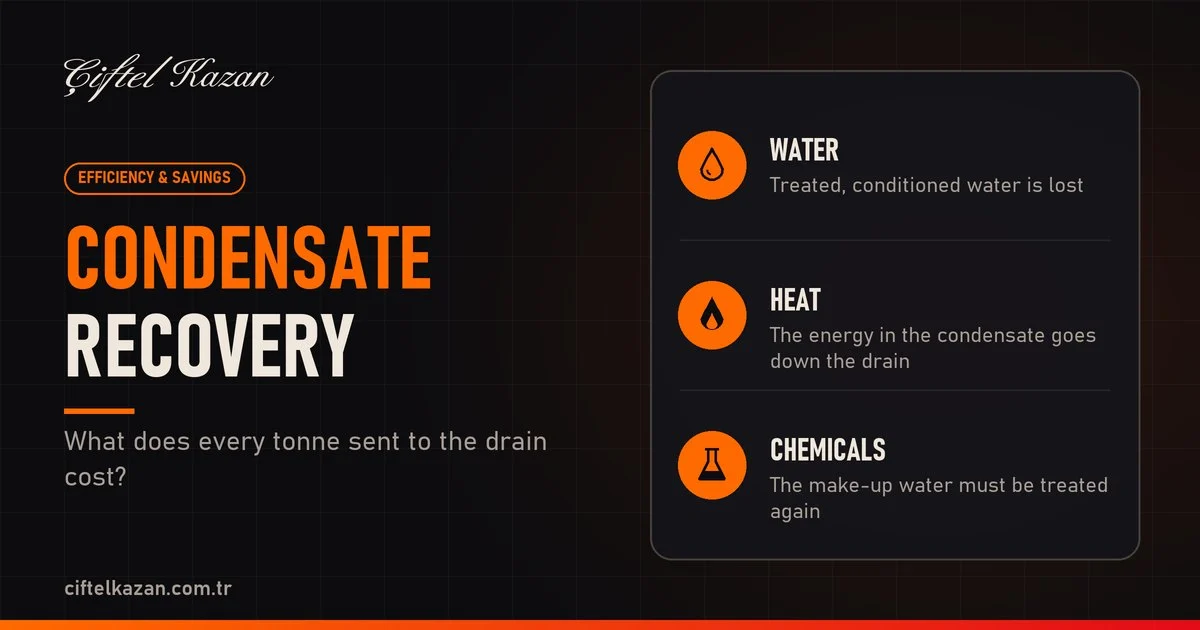
With every metric ton of condensate discharged into the sewer, three things are lost:
- Heat: Condensate is often between 80–95 °C. The fresh water used to replace it, however, is around 10–20 °C. The difference represents the heat the boiler must generate by burning additional fuel.
- Water: For every liter of condensate lost, water from the municipal supply or a well is used as a replacement.
- Treatment and chemicals: Condensate is water that has already been softened and conditioned. Fresh makeup water, on the other hand, requires additional softening, salt, resin, and chemicals.
In addition, condensate is very clean in terms of total dissolved solids (TDS). As the condensate ratio increases, less salt accumulates in the boiler water and the need for blowdown decreases; this reduces the loss of hot water and energy through blowdown.
Sample Calculation: Annual Cost of Condensate Discharged to the Drain
The following calculation is based on assumptions used to illustrate the method. You can follow the same steps using your own plant’s values.
| Assumptions | Value |
|---|---|
| Daily steam consumption | 40 metric tons |
| Recoverable condensate ratio | 60% (24 metric tons per day) |
| Condensate temperature / fresh water temperature | 80 °C / 15 °C |
| Fuel | Soma coal, approximately 5,000 kcal/kg |
| Boiler efficiency | 75% |
| Coal price (average estimate) | 11,000 TL/metric ton |
| Annual operating days | 300 days |
1. Heat loss: 24,000 kg × (80 − 15) °C × 1 kcal/kg°C ≈ 1,560,000 kcal/day
2. Coal required to generate this heat: 1,560,000 ÷ (5,000 × 0.75) ≈ 416 kg/day
3. Annual coal loss: 416 kg × 300 days ≈ 125 metric tons
4. Annual fuel cost: 125 metric tons × 11,000 TL ≈ 1,375,000 TL
In addition, approximately 7,200 m³ of water (24 metric tons × 300 days) is lost annually, along with the cost of water softening and chemical treatment. In other words, in this example, the annual cost of the condensate discharged into the sewer exceeds one million lira in fuel costs alone.
Why Is Condensate Lost?
- Distant consumption points: Piping and pump investments are required to recover condensate; at distant locations, this investment may be postponed.
- Contamination concerns: Condensate from heat exchangers that risk coming into contact with the product during the process should not be returned to the boiler uncontrolled.
- Malfunctioning steam traps: Traps that remain open allow live steam to escape; those that remain closed fill the equipment with condensate, reducing efficiency.
- Flash steam: When high-pressure condensate enters a low-pressure tank, a portion of it re-evaporates. This flash steam is often vented to the atmosphere.
Solutions for Condensate Recovery
Trap Maintenance
Steam traps are small but critical pieces of equipment. Regular inspection to identify and replace those that remain open or become clogged reduces both steam and condensate loss.
Utilization of Flash Steam
Low-pressure steam generated when high-pressure condensate is directed into a flash tank can be used in low-pressure applications such as heating. The remaining condensate is then sent to the collection system.
How Is a Condensate Return System Installed?
A basic condensate return system consists of a condensate tank that collects condensate from consumers, condensate pumps that transport the condensate to the boiler room, and return lines that are properly sloped and insulated. When determining pipe diameters, the flash steam generated along with the condensate must be taken into account; otherwise, pressure buildup and water hammer may occur in the pipes. Check valves on both sides of the pumps, level control in the tank, and insulation of the lines against heat loss ensure that the system operates both safely and efficiently.
Contamination Control
By installing a conductivity meter and an automatic bypass (dump) valve on lines at risk of contamination, dirty condensate is prevented from entering the boiler, while clean condensate continues to be recovered.
Protection of Condensate Lines
Acidic corrosion in condensate lines can be limited by removing carbon dioxide from the feedwater in a deaerator and through proper chemical treatment. We explained the role of the deaerator in our article on deaerators.
Let’s Evaluate Your Boiler Room Together
As Çiftel Kazan, we have been manufacturing steam, thermal oil, and hot water boilers at our facility in Kemalpaşa, Izmir, since 1986. Contact us or reach out via the +90 232 479 11 21 / +90 544 479 11 21 numbers to assess the current condition of your boiler room together and discuss what can be done to improve efficiency and reduce costs.
Frequently Asked Questions
Not all of it, in most plants. In processes where steam is fed directly into the product (such as injection or humidification), no condensate is formed; lines with a high risk of contamination are evaluated separately. However, it is often possible to increase the proportion of recoverable condensate.
Clean condensate is the best feedwater for a boiler. The risk lies in the condensate becoming contaminated with oil, product, or process chemicals. Therefore, continuous monitoring should be performed on lines where contamination is a possibility.
This depends on the amount of condensate, its temperature, fuel prices, and the required pipeline length. You can calculate the annual loss by applying the example calculation above to your own values and compare it to the investment cost.
Other Posts
All
Need a boiler or pressure vessel?
Let’s plan the best solution for your project together, backed by 40 years of engineering experience.